
 |
|||||||||
|
|
Table of Contents:
|
|||||||
|
|||||||||
|
TWDT 1 (gzipped text file) TWDT 2 (HTML file) are files containing the entire issue: one in text format, one in HTML. They are provided strictly as a way to save the contents as one file for later printing in the format of your choice; there is no guarantee of working links in the HTML version. | |||
|
|||
 , http://www.linuxgazette.com/ , http://www.linuxgazette.com/This page maintained by the Editor of Linux Gazette, gazette@ssc.com
Copyright © 1996-1999 Specialized Systems Consultants, Inc. | |||
|
|||
This FAQ is updated at the end of every month. Because it is a new feature, it will be changing significantly over the next few months.
These are the most Frequently Asked Questions in the LG Mailbag. With this FAQ, I hope to save all our fingers from a little bit of typing, or at least allow all that effort to go into something No (Wo)man Has Ever Typed Before.
Other archive formats. We need to keep disk space on the FTP site at a minimum for the sake of the mirrors. Also, the Editor rebels at the thought of the additional hand labor involved in maintaining more formats. Therefore, we have chosen the formats required by the majority of Gazette readers. Anybody is free to maintain the Gazette in another format if they wish, and if it is available publicly, I'll consider listing it on the mirrors page.
Zip, the compression format most common under Windows. If your unzipping program doesn't understand the *.tar.gz format, get Winzip at www.winzip.com.
Macintosh formats. (I haven't had a Mac since I sold my Mac Classic because Linux wouldn't run on it. If anybody has any suggestions for Mac users, I'll put them here.)
Other printable formats.
E-mail. The Gazette is too big to send via e-mail. Issue #44 is 754 KB; the largest issue (#34) was 2.7 MB. Even the text-only version of #44 is 146 K compressed, 413 K uncompressed. If anybody wishes to distribute the text version via e-mail, be my guest. There is an announcement mailing list where I announce each issue; e-mail lg-announce-request@ssc.com with "subscribe" in the message body to subscribe. Or read the announcement on comp.os.linux.announce.
On paper. I know of no companies offering printed copies of the Gazette.
Yes, yes, yes and yes. See the mirrors page. Be sure to check all the countries where your language is spoken; e.g., France and Canada for French, Russia and Ukraine for Russian.
You're probably looking at an unmaintained mirror. Check the home site to see what the current issue is, then go to the mirrors page on the home site to find a more up-to-date mirror.
If a mirror is seriously out of date, please let gazette@ssc.com know.
Use the Linux Gazette search engine. A link to it is on the Front Page, in the middle of the page. Be aware this engine has some limitations, which are listed on the search page under the search form.
Use the Index of Articles. A link to it is on the Front Page, at the bottom of the issues links, called "Index of All Issues". All the Tables of Contents are concatenated here onto one page. Use your browser's "Find in Page" dialog to find keywords in the title or author's names.
There is a seperate Answer Guy Index, listing all the questions that have been answered by the Answer Guy. However, they are not sorted by subject at this time, so you will also want to use the "Find in Page" dialog to search this listing for keywords.
The Linux Gazette is dependent on Readers Like You for its articles. Although we cannot offer financial compensation (this is a volunteer effort, after all), you will earn the gratitude of Linuxers all over the world, and possibly an enhanced reputation for yourself and your company as well.
New authors are always welcome. E-mail a short description of your proposed article to gazette@ssc.com, and the Editor will confirm whether it's compatible with the Gazette, and whether we need articles on that topic. Or, if you've already finished the article, just e-mail the article or its URL.
If you wish to write an ongoing series, please e-mail a note describing the topic and scope of the series, and a list of possible topics for the first few articles.
The following types of articles are always welcome:
We have all levels of readers, from newbies to gurus, so articles aiming at any level are fine. If you see an article that is too technical or not detailed enough for your taste, feel free to submit another article that fills the gaps.
Articles not accepted include one-sided product reviews that are basically advertisements. Mentioning your company is fine, but please write your article from the viewpoint of a Linux user rather than as a company spokesperson.
If your piece is essentially a press release or an announcement of a new product or service, submit it as a News Bytes item rather than as an article. Better yet, submit a URL and a 1-2 paragraph summary (free of unnecessary marketoid verbiage, please) rather than a press release, because you can write a better summary about your product than the Editor can.
Articles not specifically about Linux are generally not accepted, although an article about free/open-source software in general may occasionally be published on a case-by-case basis.
Articles may be of whatever length necessary. Generally, our articles are 2-15 screenfulls. Please use standard, simple HTML that can be viewed on a wide variety of browsers. Graphics are accepted, but keep them minimal for the sake of readers who pay by the minute for on-line time. Don't bother with fancy headers and footers; the Editor chops these off and adds the standard Gazette header and footer instead. If your article has long program listings accompanying it, please submit those as separate text files. Please submit a 3-4 line description of yourself for the Author Info section on the Back Page. Once you submit this, it will be reused for all your subsequent articles unless you send in an update.
Once a month, the Editor sends an announcement to all regular and recent authors, giving the deadline for the next issue. Issues are usually published on the last working day of the month; the deadline is seven days before this. If you need a deadline extension into the following week, e-mail the Editor. But don't stress out about deadlines; we're here to have fun. If your article misses the deadline, it will be published in the following issue.
Authors retain the copyright on their articles, but distribution of the Gazette is essentially unrestricted: it is published on web sites and FTP servers, included in some Linux distributions and commercial CD-ROMs, etc.
Thank you for your interest. We look forward to hearing from you.
Certainly. The Gazette is freely redistributable. You can copy it, give it away, sell it, translate it into another language, whatever you wish. Just keep the copyright notices attached to the articles, since each article is copyright by its author. We request that you provide a link back to www.linuxgazette.com.
If your copy is publicly available, we would like to list it on our mirrors page, especially if it's a foreign language translation. Use the submission form at the bottom of the page to tell us about your site. This is also the most effective way to help Gazette readers find you.
 ) To recognize and give thanks to our
sponsors, we display their logo.
) To recognize and give thanks to our
sponsors, we display their logo.
If you would like more information about sponsoring the Linux Gazette, e-mail sponsor@ssc.com.
This section comprises the most frequently-asked questions in The Mailbag and The Answer Guy columns.
Check the FAQ. (Oh, you already are.
)
Somewhat more seriously, there is a Linux FAQ located at
http://www.linuxdoc.org/FAQ/Linux-FAQ.html which you might
find to be helpful.
For people who are very new to Linux, especially if they are also new to computing in general, it may be handy to pick up one of these basic Linux books to get started:
Mailing lists exist for almost every application of any note, as well as for the distributions. If you get curious about a subject, and don't mind a bit of extra mail, sign onto applicable mailing lists as a "lurker" -- that is, just to read, not particularly to post. At some point it will make enough sense that their FAQ will seem very readable, and then you'll be well versed enough to ask more specific questions coherently. Don't forget to keep the slice of mail that advises you how to leave the mailing list when you tire of it or learn what you needed to know.
You may be able to meet with a local Linux User Group, if your area has one. There seem to be more all the time -- if you think you may not have one nearby, check the local university or community college before giving up.
And of course, there's always good general resources, such as the Linux
Gazette
Questions sent to gazette@ssc.com will be published in the Mailbag in the next issue. Make sure your From: or Reply-to: address is correct in your e-mail, so that respondents can send you an answer directly. Otherwise you will have to wait till the following issue to see whether somebody replied.
Questions sent to linux-questions-only@ssc.com will be published in The Answer Guy column.
If your system is hosed and your data is lost and your homework is due tomorrow but your computer ate it, and it's the beginning of the month and the next Mailbag won't be published for four weeks, write to the Answer Guy. He gets a few hundred slices of mail a day, but when he answers, it's direct to you. He also copies the Gazette so that it will be published when the month end comes comes along.
You might want to check the new Answer Guy Index and see if your question got asked before, or if the Answer Guy's curiosity and ramblings from a related question covered what you need to know.
An excellent summary of the current state of WINE, DOSEMU and other Windows/DOS emulators is in issue #44, The Answer Guy, "Running Win '95 Apps under Linux".
There is also a program called VMWare which lets you run several "virtual computers" concurrently as applications, each with its own Operating System. There is a review in Linux Journal about it.
Answers in either the Tips or Answer Guy columns which relate to troubleshooting hardware, might be equally valuable to Linux and Windows users. This is however the Linux Gazette... so all the examples are likely to describe Linux methods and tools.
The Answer Guy has ranted about this many times before. He will gladly answer questions involving getting Linux and MS Windows systems to interact properly; this usually covers filesystems, use of samba (shares) and other networking, and discussion of how to use drivers.
However, he hasn't used Windows in many years, and in fact avoids the graphical user interfaces available to Linux. So he is not your best bet for asking about something which only involves Windows. Try one of the Windows magazines' letter-to-the-editor columns, an open forum offered at the online sites for such magazines, or (gasp) the tech support that was offered with your commercial product. Also, there are newsgroups for an amazing variety of topics, including MS Windows.
The usual command to ask for a help page on the command line is the word man followed by the name of the command you need help with. You can get started with man man. It might help you to remember this, if you realize it's short for "manual."
A lot of plain text documents about packages can be found in /usr/doc/packages in modern distributions. If you installed them, you can also usually find the FAQs and HOWTOs installed in respective directories there.
Some applications have their own built-in access to help files (even those are usually text stored in another file, which can be reached in other ways). For example, pressing F1 in vim, ? in lynx, or ctrl-H followed by a key in Emacs, will get you into their help system. These may be confusing to novices, though.
Many programs provide minimal help about their command-line interface if given the command-line option --help or -?. Even if these don't work, most give a usage message if they don't understand their command- line arguments. The GNU project has especially forwarded this idea. It's a good one; every programmer creating a small utility should have it self-documented at least this much.
Graphical interfaces such as tkman and tkinfo will help quite a bit because they know where to find these kinds of help files; you can use their menus to help you find what you need. The better ones may also have more complex search functions.
Some of the bigger distributions link their default web pages to HTML versions of the help files. They may also have a link to help directly from the menus in their default X Windowing setup. Therefore, it's wise to install the default window manager, even if you (or the friend helping you) have a preference for another one, and to explore its menus a bit.
It's probably a winmodem. Winmodems suck for multiple reasons:
So, yeah, there can be good internal modems, but it's more worthwhile to get an external one. It will often contain phone line surge suppression and that may lead to more stable connections as well.
Write the Gazette at gazette@ssc.com
|
Contents: |
Answers to these questions should be sent directly to the e-mail address of the inquirer with or without a copy to gazette@ssc.com. Answers that are copied to LG will be printed in the next issue in the Tips column.
Before asking a question, please check the new Linux Gazette FAQ to see if it has been answered there.
 Sun, 05 Sep 1999 04:09:46 PDT
From: <javafun@excite.com>
Subject: Linux in Algeria
I would like to thank all people who replied to me
I am a third world LINUX user, in my country there is only windoze as an OS, none know about the advantages of LINUX, now I am going to set up a web site about LINUX so help me please, any printed magazine, books, free cd-rom will be a great help. actually my video card is an SIS 5597 so please if any one who can send me a free LINUX distribution( especially RH 6 it's easy to install, I have RH5.1)with XFREE86 3.3.1 to support my video card.
sorry for my silly english, and keep the good work
friendly mimoune
my address is:
MR djouallah mimoune
ENTP garidi, vieux kouba algiers cp 05600
algeria.
Sun, 12 Sep 1999 15:18:59 -0400
From: Jim Bruer <jbruer@flashcom.net>
Subject: Postfix article
I just installed Postfix on Suse 6.1. It seems a much easier mailer to install than any of the others I've read about in your recent issues (which were great btw). There is an active newsgroup and the author of the program responds VERY fast to stupid newbie questions. I speak from experience : ) From debian newsgroup postings it appears that Postfix is going to become their standard. Check it out, I'd love to see an article on it since I'm trying to move beyond the newbie stage and really understand this whole mail business.
Sun, 12 Sep 1999 22:00:49 +0200 (CEST)
From: <chimbis@skjoldebrand.org>
Subject: VPN and Firewall with Linux
Hi,
We are considering investing in a firewall and VPN for our network at work (a 3rd world aid organisation). We haven't deemed it necessary until now when we will upgrade to Novell Netware 5 which is mainly TCP/IP-based. We have funds for investing in Novell BorderManager as well.
However, we have been talking about having our own DNS server as well as firewall. Also we would like to be able to connect our offices around the world to the network by VPN. BorderManager has all these facilities but for a price. Is there some comprehensive Linux source (written, on-line, software) about these issues. Even a list of HOWTOs would be OK.
TIA,
Martin Sjödebrand
[Would somebody like to write an article about connecting several local networks securely over the Internet? There must be some Gazette readers who have such a network running in their office. -Ed.]
Thu, 9 Sep 1999 22:24:11 -0700
From: Lic. Manuel Nivar <mm.guzman@codetel.net.do>
Subject: Descompiler
Hi, My name is Manuel Nivar I dont know how to install a script for irc.chat because I don know how to descompiler. Please Help me.
The Linux Gazette Editor wrote:
Hi. This will be published in the October Gazette. I don't use IRC, so I'm afraid I can't personally offer any suggestions. What does "descompiler" mean? Do you mean you can't compile the program?
Manuel replied:
Yes I dont know how to descompiler
[I'm still hoping somebody will write some articles about IRC. It is certainly a popular topic among Gazette readers. -Ed.]
Thu, 02 Sep 1999 00:48:42 -0400
From: Leslie Joyce <blumagic@bellatlantic.net>
Subject: Printing lines of black
Hi,
As a newbie to linux,I am having a several problems with getting linux to work properly,mainly now, I am having a problem with my printer HP 693C. I can print, but on every line of copy(words)after the sentence ends,I get a line of solid black .As I am dual booting and my printer works in Win95,I am thinking this is a linux driver problem.I am using the 550 C driver. I am using Caldera 2.2 I used the graphical interface to install the printer . Any thoughts,guesses or ideas as to where to go to find a solution?
Thanks for your time and help
Les.................
Fri, 3 Sep 1999 10:30:24 +1000
From: Binjala <binjala@hinet.net.au>
Subject: Winmodems
It wasn't until I had my own version of MS Windoze -albeit someone else has the registration, disc etc- that I realised how much I'd like to use something else... the I was shown linux, so Ive got RedHat, but now I find I've got Winmodem, Eagle 1740 AGP VGA Card, and Creative Labs Sound Blaster PCI64. I realise the modem sucks, where can I find if the others are compatible? Are they compatible? Can you recommend a replacement 56K modem? The guy who built this box for me has never used Linux, so he's not very useful. Help!
Simon.
[Any modem except a winmodem should work fine. If it says it works with DOS and/or Macintosh as well as Windows, it should be OK.See the Hardware Compatibility HOWTO for details.
An index of all the HOWTOs is at www.ssc.com/mirrors/LDP/HOWTO/HOWTO-INDEX-3.html#ss3.1 -Ed.]
Fri, 03 Sep 1999 12:44:59 +0800
From: Jeff Bhavnanie <jeff@c-a-s-h.com>
Subject: compling network driver.
I've got the source code for my network card (SiS900), when I issue the compile command as described in the docs, i get no errors and the *.o file is created. When I issue 'insmod sis900.o' i get a list of errors. I'm a complete newbie at compiling things.
Can anyone else compile the source into object file for me? I'm running Mandrake 6.0.
Thanks
Jeff
Fri, 03 Sep 1999 11:06:14 +0000
From: Pepijn Schmitz <p.schmitz@xpuntx.nl>
Subject: Help: printing problem.
Hi,
I'm having trouble getting a Solaris box to print on my Linux print server. The Linux box has a printer set up that prints to a Netware network printer. This works, I can print from Netscape, Star Office, etc. I've set up a network printer on a Solaris 7 machine that prints to this machine. This also works, for text files. But when I try to print a page from Netscape, nothing happens, and the following appears in my messages file (maas is my Linux machine with the Netware printer, amazone.xpuntx.nl is the Solaris machine):
Sep  3 12:55:18 maas lpd[9788]: amazone.xpuntx.nl requests recvjob lp
Sep  3 12:55:18 maas lpd[9788]: tfA001amazone.xpuntx.nl: File exists
Sep  3 12:55:18 maas lpd[9789]: amazone.xpuntx.nl requests recvjob lp
Sep  3 12:55:18 maas lpd[9789]: tfA001amazone.xpuntx.nl: File exists
This repeats itself every minute. I checked, and the tfA001amazone.xpuntx.nl file really does not exist anywhere on my system. There is a cfA001amazone.xpuntx.nl file in /var/spool/lpd/lp however, and if I remove this file the next time around it says this in the messages file:
Sep  3 13:00:27 maas lpd[9854]: amazone.xpuntx.nl requests recvjob lp
Sep  3 13:00:27 maas lpd[9855]: amazone.xpuntx.nl requests recvjob lp
Sep  3 13:00:27 maas lpd[9855]: readfile: : illegal path name: File
exists
This happens once. The next minute the four lines I gave earlier reappear, and the cfA001amazone.xpuntx.nl file has reappeared.
I hope someone can help me out here, this has got me stumped! Thanks in advance for anyone who can shed some light...
Regards,
Pepijn Schmitz
Fri, 3 Sep 1999 11:36:57 -0400 (EDT)
From: Tim <ice@bigfoot.com>
Subject: 2gig file size limit?
Greetings,
I have a box on my network running RedHat 6.0 (x86) that is going to be
used primarily for backing up large database files. These files are
presently 25 gigs in size. While attempting a backup over Samba, I
realized that the file system would not allow me to write a file > 2gig to
disk. I tried using an large file system patch for kernel 2.2.9, but that
only allowed me to write 16 gigs, and it seemed buggy when it was doing
that even. Doing an 'ls -l' would show me that the file size of the backup
was about 4 gig, but the total blocks in the directory with no other files
there indicated a much higher number like so:
[root@backup ]# ls -l
total 16909071
-rwxr--r--   1 ntuser   ntuser   4294967295 Sep  2 19:45 file.DAT
I am well aware that a 64 bit system would be the best solution at this point, but unfortunately i do not have those resources. I know BSDi can write files this big, as well as NT on 32 bit systems.. i am left wondering, why can't linux?
Thanks in advance.
-Tim
Fri, 3 Sep 1999 18:03:22 +0200
From: Service Data <basciuv@tin.it>
Subject: Linux.
È possibile sapere qual'è l'ultima versione di linux in comercio? È possibile che sia uscita la versione 6.2?
Attendo Vs. risposta Grazie.
[Hi. Sorry, I don't speak Italian. "Linux" technically refers only to the kernel. The kernel is at version 2.2.12. We track the kernel version on the Linux Journal home page, www.linuxjournal.com. The original site is www.kernel.org.The distribution you buy in a store contains not just the Linux kernel, but a lot of software from a lot of sources. Each distribution has its own numbering system. RedHat is at 6.0. SuSE just released 6.2. The other distributions have other numbers. We list the versions of the major distributions at www.linuxjournal.com, "How to Get Linux".
There are Italian speakers who read the Gazette; perhaps they can give a better answer than this. -Ed.]
Sat, 4 Sep 1999 08:35:51 +0530
From: A.PADMANARAYANAN <semco@vsnl.com>
Subject: Reading Linux partitions from NT
Dear sir, can you please tell me how can i access linux partitions from windows NT or 98? is it possible? please help me or point me to any resources man pages or URLs i will work on it!
Thanks in advance!
sincerely
Vijay
Pune, India
[There is a Windows 95 tool to do this, but I have forgotten its name. It wasn't in a very advanced stage the last time I looked at it. It would be easier to go the other way and have Linux mount your Windows partitions and copy the files there so that Windows can see them. Run "man mount" for details. -Ed.]
Sat, 4 Sep 1999 21:40:47 +0530
From: Joseph Bill E.V <bill@md4.vsnl.net.in>
Subject: Chat server
Dear sir,
Is there any chat server for linux users to share their views
Regards,
Bill
Sat, 11 Sep 1999 12:55:54 -0600
From: Daniel Silverman <argent@mcn.net>
Subject: Linux Internet forums
Do you know of any Linux internet forums? If you do, I will be very grateful for their urls.
Sun, 05 Sep 1999 02:34:41 -0300
From: Erik Fleischer <ferik@iname.com>
Subject: How to prevent remote logins as root
For security reasons, I would like to make it impossible for anyone logging in remotely (via telnet etc.) to log in as root, but so far haven't been able to figure out how to do that. Any suggestions?
Sun, 5 Sep 1999 23:27:16 +0200
From: =?iso-8859-2?B?TWljaGGzIE4u?= <sundayk@poczta.onet.pl>
Subject: When RIVA TNT 2 drivers for XWindows ?
When XWindows will work properly with vga's with chipset RIVA TNT 2 ? When I'm trying to use RIVA TNT there are only 16 colors and very,very poor resolution.
Mon, 6 Sep 1999 01:40:38 +0200
From: Per Nyberg <per.nyberg@alfa.telenordia.se>
Subject: Mandrake
Hi, Im thinking of changing to Linux and I will buy Mandrake Linux. Is Red Hat better or is it a good idea of buying Mandrake?
Sun, 05 Sep 1999 19:24:28 -0600
From: Dale Snider <dsnider@nmia.com>
Subject: neighbour table overflow
I was running quite a long time with NFS and transmission stopped. I get:
Sep  6 00:03:20 coyote kernel: eth0: trigger_send() called with the
transmitter busy.
I rebooted the machine I was connected to and I get the below (part of /var/log/messages file. Not all error statements shown):
Sep  6 17:57:04 beartooth kernel: neighbour table overflow
Sep  6 17:57:04 beartooth kernel: neighbour table overflow
Sep  6 17:57:04 beartooth rpc.statd: Cannot register service: RPC:
Unable to send; errno = No buffer space available
Sep  6 17:57:04 beartooth nfs: rpc.statd startup succeeded
Sep  6 17:57:04 beartooth rpc.statd[407]: unable to register (SM_PROG,
SM_VERS, udp).l:
df gives:
Filesystem           1k-blocks      Used Available Use% Mounted on
/dev/hda2               792800    628216    123619  84% /
/dev/hda1               819056    369696    449360  45% /NT
/dev/hda4              7925082   4892717   2621503  65% /home
I can't find a reference to this error.
Using RH 6.0 on Intel Pentium III 500 Mhz.
Cheers
Dale
Mon, 06 Sep 1999 02:17:37 +0000
From: Patrick Dunn <patdunn@dreamscape.com>
Subject: Parallel Port Scanners and Canon BJC-2000
I have two questions...
1)Does anyone have a driver written to work with Parallel port scanners? I have one of these dastardly things that I wish I didn't buy but the price was too good to pass up. It's a UMAX Astra 1220P.
2)I have recently picked up a Canon BJC-2000 inkjet printer and it will print in B&W under Linux using the BJC-600/4000 driver under Ghostscript 5.10 (Mandrake Distro 6.0). Is there a native driver in the works? Color printing under this printer can be problematic.
Thanks, Pat
Tue, 07 Sep 1999 21:59:49 -0500
From: balou <bigidiot4672@yahoo.com>
Subject: shell programming
Could you point me to a good source for shell programming. I would prefer to find something off the internet taht's free. I've tried multiple web searches, but usually just come up with book reviews and advertisements.... If there are no free resources on the web, which book would you recommend for a relatively novice at Linux with experience in basic, logo, fortran, pascal, and the usual msdos stuff.
Wed, 08 Sep 1999 21:35:04 +0700
From: Ruangvith Tantibhaedhyangkul <ruangvith@linuxfan.com>
Subject: Configure X to work with Intel 810 chipset
Hi again,
I just bought a new computer. It has an "on-board" video card, Intel 810 chipset, or somewhat like that. I couldn't configure X to work with this type of card. First, I let Linux probed, it failed. Then I looked at the list, of course, it wasn't there. Then I tried an unlisted card and configured it as a general svga, it still failed. What to do now?
Wed, 8 Sep 1999 16:57:17 +0200
From: <rakeshm@za.ibm.com>
Subject: Internet connection problem !
Hi all
I hope someone can lend some advise ...
I have a PII 350 Mhz box with 64 MB ram running RH 6.0. I am using KDE as a wm and am trying to set up a RELIABLE connection to my ISP. I am using a ZOLTRIX (Rockwell) 56K modem, and kppp to dial in to my ISP.
My problem is that my I can never connect consistently.. in other words today it works fine but tomorrow it will throw me out ... It seems to dial in fine but when it tries to 'authenticate' my ID and password it bombs out ! It connects fine every time if I boot into Windoze 98.
Does anyone have any ideas as to why this might be happening ?
Thanks in advance
Regards
Rakesh Mistry
Fri, 10 Sep 1999 13:28:07 +1000
From: Les Skrzyniarz <leselec@alphalink.com.au>
Subject: Loading HTML back ssuse
Iam using win98 IE5 and when Itry to load the complete issues eg.Issue 42 it stops loading at some random point on the page, and as such I can not save the complete issues(some not all) even when I come back to it agin at a later time the problem persists. The problem is not at my end as I do not have this problem with any other page on the internet.Can you offer a reason for this or a solution.
Thanks [Hi. This will be published in the October Gazette, and
we'll see if any other readers are having the same problem. I have not
heard any other complaints about this so far. I have not
used Win98 or IE5, so I can't suggest anything directly.
Which site are you reading the Gazette at? Can you try another
mirror?
You can try downloading the Gazette via FTP and reading it locally.
See
ftp://ftp.ssc.com/pub/lg/README for details.
It may be related to the size of the file and a misconfigured
router on the network between us and you. issue45.html is 428K.
Are any of the other pages you visit that big? -Ed.]
Les.S
Fri, 10 Sep 1999 13:32:21 -0500
From: root <eddie@infored.com.mx>
Subject: (no subject)
Hi! I have a question for you... Is there an utility like fsck but for Macintosh HFS File systems? I want to recover a damaged one due to power supply problems.
Fri, 10 Sep 1999 13:32:21 -0500
From: root <eddie@infored.com.mx>
Subject: (no subject)
Hi! I have a question for you... Is there an utility like fsck but for Macintosh HFS File systems? I want to recover a damaged one due to power supply problems.
Mon, 13 Sep 1999 10:22:31 -0700
From: MaxAttack <maxmpd@zip.com.au>
Subject: Re: hello
I was looking into CS software for linux, And one of the tools i was looking into was software to graph the internet its etc map out the registerd users on the arpnet. I was woundering if u happend to have any infomation in any of your magazines on this topic
The Linux Gazette Editor wrote:
No, I don't know of any such software.
What is it you wish to do? Find out who is on each computer? The Internet doesn't really have a concept of "registered user", because the concept of "What is a user?" was never defined Internet-wide.
In any case, you'd have to poll every box to find out what it thinks its current user is. But this identity has no real meaning outside the local network. For Windoze boxes it may be totally meaningless, because users can set it to anything they want. And how would you even find the boxes in the first place? Do a random poll of an IP range? That sounds like Evil marketoid or cracking activity. In any case, if the machines are behind dynamic IPs, as is common with ISPs nowadays, there's no guarantee you'll ever be able to find a certain machine again even if you did find it once.
Manuel replied:
i was thinking of just pinging all the registerd users at some DNS databases over a period of time. And using some software to create a graphical user interface for it, or such.
The Linux Gazette Editor asked:
Are you talking about a network analyzing program like those products that show an icon in red or page the system administrator if a computer goes down?
I assume by "user" you mean a particular machine rather than a user-person, since the DNS doesn't track the latter.
Manuel replied:
hehe sorry for the confusion what i was trying to pass on what the notion of a software that allows u to track out all the registed Boxes on the internet and graph them into a nice graphical picture. so it looks something like this hopefully this diagram helps:
                                  |---------------|
                                  | InterNIC      |
                                  |               |
                                  |---------------|

                                  /              \
                                 /                \
                                /                  \

                         |---------------|      |---------|
                         | linuxstart.com|      |   blah. |
                         |               |      |   com   |
                         |---------------|      |---------|
                                |
                                |
                         |---------------|
                         |   */Any Sub   |
                         |     Domain    |
                         |---------------|
Sun, 12 Sep 1999 17:19:10 -0400
From: William M. Collins <bcollins@aug.com>
Subject: HP Colorado 5GB
Using Red Hat 5.2
I purchased a HP Colorado 5GB tape drive on reccomendation of a friend. He helped install RH 5.2. And using a program on the system named Arkeia configured the Colorado from this program. This friend has moved from the area.
My questions are:
Thanks
Bill
Tue, 14 Sep 1999 09:56:39 +0800
From: a <leeway@tonghua.com.cn>
Subject: program that play Video Compact Disk (VCD)
i have RH 5.1. Is there any program that play Video Compact Disk (VCD)?
Thu, 16 Sep 1999 20:34:14 -0400
From: madhater <madhater@rochester.rr.com>
Subject: ahhhhh i heard that
linux will run out of space in 2026 cause of some bs about that i counts in units and the hard drive will be filled this is not true .... right!
[No. Linux, like most Unixes, has a "Year 2032 problem" (I forget the exact year) because the system clock counts the seconds since January 1, 1970, and that number will overflow a 32-bit integer sometime in the 2020s or 2030s.People generally assume we will all have moved to 64-bit machines by then, which have a 64-bit integer and thus won't overflow until some astronomical time thousands of years from now. If 32-bit machines are still common then, expect some patches to the kernel and libraries to cover the situation. (People will have to check their database storage formats too, of course.)
I have never heard of any time-specific problems regarding i-nodes and disk space. A Unix filesystem has both a limit of the amount of data it can hold and the number of files it can contain. The number of files is the same as the number of i-nodes, which is fixed at format (mkfs) time. Run "df -i" to see what percentage of i-nodes are used. Every file and directory (including every symbolic link) uses one i-node. (Hard links to the same file share the i-node.) For normal use it's never a problem. However, if you have a huge number of tiny files (as on a high-volume mail or news server), it may be worth formatting the partition with a larger-than-usual number of i-nodes. None of this has anything to do with the year, though. -Ed.]
Fri, 17 Sep 1999 21:54:30 -0700
From: Ramanathan Prabakaran <rampraba@one.net.au>
Subject: run-time error on cplusplus programme
I have edited the sourcecode on windows Notepad, compiled on cygwin32 and run the programme. The source code contains fstream class. It is about file input/output. I have created the input file on the same windows notepad. But the programme does not open or read the contents of the infut file.
Help please
[I haven't quite gotten to the point of banning Windoze questions in the Mailbag because it's hovering at only one or two per issue. But I'm starting to think about it.However, I do want to support the use of free/open source compilers on Windows, especially since the Cygnus ones are (ahem) "our" compilers. Are there any better forums for Cygnus-on-Windoze to refer people to? -Ed.]
Sun, 19 Sep 1999 20:12:47 +0200
From: David Le Page <david@e-mg.co.za>
Subject: Making Linux talk to an NT network
I want to get Linux running on my PC at work, and talking to the NT network for file sharing and printer use. Okay, okay, I know the theory -- get samba up and running, read the manual, and make it all happen. But I'm not a networking guru, and I'm battling to understand samba. And everything I read about it seems to be focused on gettings Win machines talking to Samba servers, not the other way around. Can anyone tell me, in 10 Easy Steps, how to get this done?
Mon, 20 Sep 1999 17:35:23 -0400
From: Mahesh Jagannath <mjaganna@us.oracle.com>
Subject: Netscape and Java
I am running Netscape Comm 4.51 on Red Hat Linux 6.0. It crashes invariably if I load a site with any Java applet etc. Is there something I am missing or is this a known bug?
Mahesh
Mon, 20 Sep 1999 16:48:35 -0500
From: <qed@tigernet.missouri.org>
Subject: Modem noises
Hi Folks,
I know this is a nitpick, but for reasons I won't go into, it's keeping me from using Linux as much as I might. Is there a way to divert the modem noises to /dev/null ? Hearing them was a help when I was debugging my connection, but now it's just a disturbance.
Thanks,
Jerry Boyd
[Add "L0M0" to your modem's initialization string. One of these sets the volume to zero; the other says never turn on the speaker. (Of course I forget which is which, which is why I set both. Can you believe how many whiches are in that last sentence?) If there is no existing initialization string, use "ATL0M0" + newline. Each modem program will need this put into its configuration file. For PPP, this would be in your chatscript.I use "L1M1", which means (1) low speaker volume, (2) turn the speaker on only after dialing and off when the connection either succeeds or fails. -Ed.]
Tue, 21 Sep 1999 08:44:19 GMT
From: raghu ram <tunkey@hotmail.com>
Subject: help
sir, I am using apache web server on Linux machine.
My problem is logrotation,to rotatelogs we should have config file given below
/var/log/messages {
           rotate 5ge.
           weekly
           postrotate
                                     /sbin/killall -HUP syslogd
           endscript
       }
config is over,but my problems is where should be setup.
please help me
Thanks
Raghu
The Linux Gazette Editor wrote:
I don't understand what the problem is. What does "where should be setup" mean?
Raghu replied:
I don't known how to run the configfile?. I went to man logrotate,just he given configfile.
Thu, 23 Sep 1999 13:11:53 +0530
From: neeti <neeti@amsoftindia.com>
Subject: linux 6.2 compatible scsi adapters
will somebody pl. tell me the list of SCSI adapters compatible to SUSE lINUX 6.2
thanx
neeti
Thu, 23 Sep 1999 17:32:46 +0200
From: De Miguel, Guillermo <guillermo.de.miguel@sap.com>
Subject: Package to install...
Hello everybody,
I have in my notebook installed RedHat 6.0 in a partition of 800Mb with several products installed. As you can suppose, I had to restrict the installation of a lot of packages due to I do not have to much free hard disk space. Sometimes, I am working with my installation, I have problems due to my Linux does not find some file(s). The question is, does somebody know a way to find the package where a file which is not installed is?. I know that there is a option in the rpm command to find the package a file belongs to. However, that file has in the hdd. Has anybody help me ?
Thanks ahead. Guillermo.
Wed, 01 Sep 1999 16:22:28 +0200
From: Alessandro Magni <magni@omega.ien.it>
Subject: Imagemap
In the need to define hotspots on some images in HTML documents, I found a total lack of programs for Linux that enable you to accomplish this task. Does somebody know what I'm searching for?
Wed, 01 Sep 1999 13:13:02 -0700
From: Jim Dennis <jimd@starshine.org>
Subject: Freedom from UCITA: Free Software
In response to Ed Foster's many recent gripes about the UCITA and the risks associated with some proprietary software licensing.
I'm sure he's heard it before but Freedom from the threat of UCITA is only as far away as your local free software mirror site (FTP and/or web based). Linux, FreeBSD (and its brethren) have licenses without any such traps(*).
* (I've appended a brief note on the two most common software licenses to forestall any argument that they DO contain "such traps.")
If the quality of Linux and other free software didn't speak for itself, the UCITA would be an incentive for its adoption.
It's as though the major commercial software publishers are in their death throes and intent on getting in one last bite, kick or scratch at their customers.
I'm not saying that free software and the open source movement is poised to wipe out proprietary software. For most free software enthusiasts the intent is to provide alternatives.
Ironically it seems as though the major proprietary software interests will obliterate themselves. The UCITA that they propose may pass and become the fulfillment of some modern Greek tragedy.
I just hope that free software enthusiasts can provide the improvements and new, free products that may become unavailable if the commercial software industry annihilates itself.
There's much work to be done.
----------------------- Appendix -----------------------------
Some software is distributed in binary form free of charge. Some proprietary software is distributed with the source code available, but encumbered by a license that limits the production of "derivative works." Those are not commonly referred to as "free software" or "open source" by computing professionals and technical enthusiasts.
However, "free software with open source" permits free use and distribution and includes source code and a license/copyright that specifically permits the creation and distribution of "derivative works" without imposition of licensing fees, royalties, etc.
That, of course is a simplification. There are extensive debates on USENet and other technical fora about the exact nature and definition of the terms "free software" and "open source."
However, that is the gist of it.
There are two major license groups for "free/open source" software: BSD (Berkeley Software Distribution) and GPL (GNU Public License).
The BSD license was created by the Regents of the University of California at Berkeley. It was orginally applied to a set of patches and software utilities to UNIX (which was then owned by AT&T). Since then the BSD license has been applied to many software packages by many people and organizations that are wholly unconnected to UC Berkeley. It is the license under which Apache, and FreeBSD are available.
The BSD license permits derivative works, even closed source commercial and proprietary ones. Its principle requirements are the inclusion of a copyright notice and a set of disclaimers (disclaiming warranty and endorsement by the original authors of the software). Many advocates consider it to be the "free-est" license short of complete and utter abandonment (true public domain).
The GPL is somewhat more complicated. It was created by the Free Software Foundation (FSF), which was founded by Richard M. Stallman (a software visionary with a religous fervor and a following to match).
The terms of the GPL which cause misunderstandings and debate revolve around a requirement that "derivative works" be available under the same licensing terms as their "source" (progenitors?).
This is referred to as the "viral nature" of the GPL.
Conceptually if I "merge" the sources to two programs, one which was under the GPL and another which was "mine" then I'm required to release the sources to my software when I release/distribute the derivative.
That's the part that causes controversy. It's often played up as some sort of "trap" into which unwary software developers will be pulled.
One misconception is that I have to release my work when I use GPL software. That's absurd, pure FUD! I can use GNU EMACS (a GPL editor) and gcc (a popular GPL compiler) to write any software I like. I can release that software under any license I like. The use of the tools to create a package doesn't make it a "derivative work." Another more subtle misconception is that I'd be forced to release the sources to any little patch that I made to a package. If I make a patch, or a complex derived work, but only use it within my own organization, then I'm not required to release it. The license only requires the release of sources if I choose to "DISTRIBUTE" my derivative.
One last misconception. I don't have to distribute my GPL software free of charge. I can charge whatever I like for it. The GPL merely means that I can't prevent others from distributing it for free, that I must release the sources and that I must allow further derivation.
The FSF has developed an extensive suite of tools. Their GNU project intends to create a completely "free" operating system. They provided the core "tool chain" that allowed Linus Torvalds and his collaborators to develop Linux. That suite is released under the GPL. Many other software packages by many other authors are also released under the GPL.
Indeed, although the Linux kernel is not a "derived work" and its developers are unaffiliated with the FSF (as a group) it is licensed under the GPL.
There are a number of derivative and variations of these licenses. Some of them may contain subtle problems and conflicts. However, the intent of the authors is generally clear. Even with the worst problems in "free" and "open source" software licenses, there is far less risk to consumers who use that software than there is from any software released under proprietary licenses that might be enforced via the UCITA.
[Jim, you get the award for the first Mailbag letter with an Appendix.There is an article about UCITA on the
Linux Journal web site, which contains an overview of UCITA's potential consequences, as well as a parody of what would happen if UCITA were applied to the auto industry. -Ed.]
Fri, 3 Sep 1999 10:32:58 +0200
From: niklaus <peter.niklaus@t-online.de>
Subject: gazette #45 - article on java
Hey, what's about that buggy article on JDE on linux - i receive nothing more than an floating point error ?!?
PN
Fri, 3 Sep 1999 19:16:19 +0200
From: <jh.terstegge@gmx.de>
Subject: Re: Ooops, your page(s) formats less-optimum when viewed in Opera
Hi Guys at Linux Gazette.
This mail responds to Bjorn Eriksson's mail in issue #45 / General Mail: SV: Ooops, your page(s) formats less-optimum when viewed in Opera (http://www.operasoftware.com/).
I have the same problem in my Opera. I tested it with Opera 3.1, 3.5 and 3.6 on Windows and the alpha release for BeOS, but every time the same problem. This is my solution for the problem: When defining this:
Jan-Hendrik Terstegge
[I tried his advice, and another Opera user said it worked. -Ed.]
Thu, 02 Sep 1999 13:44:53 -0700
From: <dstevens@bulkley.net>
Subject: misspelling
This month's linux gazette contains what is for my money the most hideous misspelling ever to appear in your pages. The article "Stripping and Mirroring RAID under RedHat 6.0" clearly does NOT refer to an attempt to remove any apparel whatsoever from our favorite distro. STRIP is to undress, STRIPE is to make a thin line, RAID does not concern itself with haberdashery or nudity.
Dave Stevens
The Linux Gazette Editor writes:
OK, fixed.
P.S. STRIP is also used in electronics, when you scrape the insulation off wires.
Mark Nielsen adds:
Oops!
Sorry!
Thanks!
I used ispell to check the spelling, dang, it doesn't help when the word you mispell is in the dictionary.
Mark
Thu, 16 Sep 1999 13:46:22 +0200 (CEST)
From: =?iso-8859-1?q?seigi=20seigi?= <seigi1999@yahoo.fr>
Subject: Linux Gazette in French
Bonjour
Je voudrai savoir si votre magazine existe en francais sinon ou si vous connaissiez un magazine en francais qui parle de Linux
Merci d avance
[There are two French versions listed on the mirrors page, one in Canada and one in France. There used to be a third version, but it no longer exists. A company wrote me and said they are working on a commercial translation as well, although I have not heard that it's available yet.
Mon, 20 Sep 1999 08:59:40 -0400
From: Gaibor, Pepe (Pepe) <gaibor@lucent.com>
Subject: What is the latest?
With great interest I got into and perused Linux Gazette. Any new stuff beyond April 1997? and if so where is it.
[You're reading it. :)If the site you usually read at appears to be out of date, check the main site at www.linuxgazette.com. Ed.]
Wed, 22 Sep 1999 9:21:17 EDT
From: Dunx <dunx@dunx.org>
Subject: Encyclopaedia Galactica != Foundation
Re: September 99 Linux Gazzette, Linux Homour piece -
Liked the operating systems airlines joke, but surely the footnote about the Encyclopaedia Galactica is in error? The only EC I know is the competitor work to the Hitch Hiker's Guide to the Galaxy in Douglas Adams' novels, radio and TV shows, and coputer games.
Cheers.
Thu, 23 Sep 1999 17:26:30 +0800
From: Phil Steege <psteege@tpg.com.au>
Subject: Linux Gazette Archives CDROM
I just wondered if there was, or if not has there ever been, any thought to publishing a Linux Gazette Archives CDROM.
Thank you for a great publication.
Phil Steege
[See the FAQ, question 2. -Ed.]
|
Contents: |
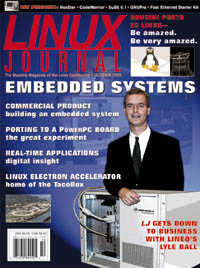
 October 1999 Linux Journal
The October issue of Linux Journal is on the newsstands now. This issue focuses on embedded systems.
Linux Journal now has articles that appear "Strictly On-Line". Check out the Table of Contents at http://www.linuxjournal.com/issue66/index.html for articles in this issue as well as links to the on-line articles. To subscribe to Linux Journal, go to http://www.linuxjournal.com/subscribe/ljsubsorder.html.
For Subcribers Only: Linux Journal archives are now available on-line at http://interactive.linuxjournal.com/
Upcoming conferences & events
Atlanta Linux Showcase. October 12-16, 1999. Atlanta, GA.
Open Source Forum. October 21-22, 1999. Stockholm, Sweden.
USENIX LISA -- The Systems Administration Conference. November 7-12, 1999. Seattle, WA.
COMDEX Fall and Linux Business Expo . November 15-19, 1999. Las Vegas, NV.
The Bazaar. December 14-16, 1999. New York, NY. "Where free and open-source software meet the real world". Presented by EarthWeb.
SANS 1999 Workshop On Securing Linux. December 15-16, 1999. San Francisco, CA. The SANS Institute is a cooperative education and research organization.
Red Hat News (Burlington Coat Factory, Japan, etc)
DURHAM, N.C.--September 7, 1999--Red Hat, Inc. today announced that Burlington Coat Factory Warehouse Corporation has purchased support services from Red Hat for its nationwide Linux deployment.
Under the agreement, Red Hat Services will provide telephone-based suppor t
to more than 260 Burlington Coat stores nationwide (including subsidiaries).
Red Hat will configure, install and provide ongoing maintenance for customized
Dell OptiPlex (R) PCs and PowerEdge servers running factory installed Red
Hat Linux. The Red Hat Linux OS-based systems will host Burlington Coat
Factory's Gift Registry and will facilitate all other in-store functions, such
as inventory control and receiving.
In addition, Red Hat has named software industry veteran Masanobu Hirano as
president of Red Hat Japan. Prior to Red Hat, Mr. Hirano was president of
Hyperion Japan, a subsidiary of Hyperion Solutions, one of the country's most
successful online analytical processing (OLAP) solution vendors. He also served
as vice president and was a board member of ASCII Corporation, one of Japan's
pioneering computer software companies.
"It might sound crazy, but we have been doing it for almost 3 years."
The Linux Bits is a weekly ezine at
www.thebits.co.uk/tlb/. It is
perfectly suited to offline viewing (no graphics or banners).
A Survey Of Web Browsers Currently Available For Linux
Here's a list of all the Linux browsers and their stage of development. Obviously if you know of one that's not on the list then please let them know. E-mail signature qutes from
Laurence Hunter -:
Oh My God! They Killed init! You Bastards! Your mouse has moved. Windows must be restarted for the change to
take effect. Reboot now? [ OK ] If Bill Gates had a nickel for every time Windows crashed... Oh
wait, he does. Feature freeze for Linux 2.3:
kernelnotes.org/lnxlists/linux-kernel/lk_9909_02/msg00460.html
HAPPY 8TH BIRTHDAY LINUX!
On the 17th September 1991, Linus e-mailed his 0.01 kernel to just four
people. Doesn't sound like much does it? Well believe it or not this was
to be the first public release of Linux.
Linuxlinks.com.
The trouble with sites that primarily focus on links to other sites, is
that they tend to be thrown together with no real thought and
organisation put into them. Fortunately LinuxLinks.com is not one of
those sites. A great place to track down information on specific
subjects concerning Linux.
LB also has a multi-part review of StarOffice.
Training Pages, an online
database of IT and management training courses in the UK, has officially passed
the threshold of 4000 entries. At the time of writing, the database detailed
4027 courses from 347 companies. These numbers will almost certainly increase
by the time this notice is released.
The press release offers a few technical details of the web site:
No other UK training site offers comparable levels of interactivity
and dynamic web services. The secret behind the site's functionality
is it's integration of open standards, open source software, and a
smattering of in-house programming trickery.
By separating the dynamic functions from the presentational elements
of HTML, the site can constantly be adapted and improved with minimal
human intervention. The programme code currently contains a host of
premium features which have yet to be activated. e.g. direct booking,
last-minute booking, course evaluation, trainer evaluation, freelance
trainers, etc.
Training Pages was developed by GBdirect, a boutique IT consultancy
and training company based in Bradford. A detailed case study of how
they designed and built the site is available from
www.gbdirect.co.uk/press/1999/trainingpages.htm
HOLLYWOOD, Florida --Arco Computer Products, Inc.,
www.arcoide.com, a leading provider of low cost IDE disk
mirroring hardware, today announced the
DupliDisk RAIDcase, a real-time backup device that offers
PC users a simple and convenient way to maintain an exact,
up-to-the-minute duplicate of their IDE hard drives.
If a hardware failure disables one of the mirrored drives, the
other takes over automatically. External LEDs change color
to indicate a failed drive and an audible alarm alerts the user
of the drive failure but there is no interruption of service. The
system continues to function normally until the user can find
a convenient time to power down and install a new drive.
Caddies remove easily to facilitate replacement of failed
drives.
The RAIDcase requires neither an ISA nor a PCI bus slot.
IDE and power cables provided by Arco connect the
RAIDcase to the computer's onboard IDE controller and
power supply. Once installed, the RAIDcase operates
transparently, providing continuous automatic hard disk
backup and disk fault tolerance. All data sent from
the PC to the primary drive is automatically duplicated
(concurrently) to the mirroring drive but the system
(and end user) sees only the primary drive.
The RAIDcase uses no jumper settings and requires no
driver, TSR or IRQ. Because it requires no device drivers,
the RAIDcase is essentially operating-system independent.
It has been tested with systems running Windows 3.x, 95, 98
and NT, as well as OS/2, DOS, Unix, Linux, Solaris386,
BSDI and Novell NetWare. Manufacturer's suggested retail
$435
Linux vendor MandrakeSoft announced a strategic partnership with
LinuxOne this week. They intend to develop Chinese language
business and personal software solutions, advancing the cause of
open-source in a potentially explosive Internet and computing
market...
E-commerce solution provider Unify Corp.,
announced this week that two of its forthcoming Internet
software releases will be certified to run on the Red Hat, Inc.
(Nasdaq: RHAT) distribution of the Linux operating system (OS)...
Navarre, a business-to-business e-commerce
company that offers music and software, announced today
that it has entered into a distribution deal with Linux developer
tools provider Cygnus Solutions. The deal is Navarre's sixth
distribution agreement for the Linux operation system and related
products...
Magic Software Enterprises unveiled the latest
version of its e-commerce server Friday, a product powered by
the Red Hat, Inc. (Nasdaq: RHAT) distribution of the red-hot
Linux operating system (OS)...
Oracle Corp. has announced that its Oracle8i
for Linux, a database designed specifically for the Internet, has
been certified to run on the Red Hat, Inc. (Nasdaq: RHAT)
distribution of the open-source operating system (OS). The
announcement officially launches a strategic partnership
between the two companies that is aimed at advancing
corporate adoption of Linux...
ANNOUNCEMENT FROM:
WM. Baker Associates
On 09/13/99 WM. Baker Associates launched the
Linux Bulletin Board at:
http://www.w-b-a.com/linux.html
This new Linux Bulletin Board provides a forum for
visitors to ask questions, learn, and share ideas about
Linux related issues and events.
Bulletin Board Categories include:
Linux Technical Information
Linux News, Events & Publications
Linux Investment Information
San Luis Obispo, CA, September 20, 1999 -- Ziatech Corporation, with
sponsorship from Intel Corporation, is hosting a continuing series of one-day
seminars focusing on real-time operating system solutions for applied computing
applications, it was announced today. Beginning in late October, the 1999
Applied Computing Software Seminar Series will feature presentations from
leading software companies, including Wind River Systems (VxWorks=AE,
Tornado(tm)), QNX Software Systems (QNX=AE, Neutrino=AE), and MontaVista
Software (Hard Hat(tm) Linux), in addition to presentations by Ziatech and
Intel. The seminar series begins in San Jose on October 29, and continues in
San Diego (November 4), Tokyo (November 8), Dallas (November 30), and Boston
(December 2). Each one-day session begin with registration at 7:30 a.m.,
includes lunch, and concludes at 5 p.m.
The Linux C Programming Lists now officially exist. They will be
archived on-line and also via majordomo. The Linux C Programming Lists
aim to help people programming linux with C. Hopefully no question will
be too simple nor too difficult for someone on the list to answer. For
anyone learning how to program linux with C these lists will be a
valuable resource to help you in your learning.
David Lloyd has agreed to host a common home page for the linux c
programming lists. It is at
users.senet.com.au/~lloy0076/linux_c_programming/index.html
The easiest way to become a member of the (dual) lists is to e-mail
listbot.com.
Linux Journal, the monthly magazine of the Linux community, is proud
to announce its leading sponsorship role in the 1999 Atlanta Linux Showcase.
The Atlanta Linux Enthusiasts and the USENIX association, in cooperation
with Linux International, are pleased to announce the Conference and Tutorials
Schedule for the 3rd Annual Atlanta Linux Showcase.
The tutorial program, sponsored and managed by the USENIX Association will
feature two days of top rate instruction in the following subjects:
The Conference program will consist of 41 sessions with up to five sessions
in each track. Our tracks cover all of the cutting edge topics in the Linux
Community today: Distributed Computing, Kernel Internals, Applications,
Security, System Administration, and Development. The sessions are lead by a
top notch line of speakers including Bernie Thompson, Eric Raymond, Phil
Hughes, Matthew O'Keefe, Jes Sorensen, Michael Hammel, Miguel de Icaza, Mike
Warfield, Steve Oualline, Dirk Hondel. Full details on the conference program
are available and online at:
www.linuxshowcase.org.
In addition to Jeremy Allison's Keynote, Norm Shryer from AT&T Research
will be giving a keynote entitled: "The Pain of Success, The Joy of Defeat:
Unix History"-the story of what happened to Unix on the way from Ken Thompson's
mind to the marketplace, and how this affects Linux.
ALS activities for attendees include 3 days of free vendor exhibits,
freeform birds-of-a- feather sessions, and the listed tutorials, keynotes, and
conference sessions.
Date: Wed, 15 Sep 1999 04:31:52 +0000 (UTC)
Richard Stallman is promoting an initiative to campaign against UCITA and
other legislation that is damaging to the free software movement.
Considering the many legislative issues that affect free software, some,
like myself, believe there is a need for a Ralph Nader type of
organization to both be a watchdog and also lobby legislators to protect
the interests of free software.
Richard Stallman has volunteered himself to lead off the initiative and
Below is his latest correspondence.
Because the free software movement encompasses both commercial and
non-commercial interests and Linux International is an association of
commercial Linux interests, it is probably not appropriate for Linux
International to attempt to serve the watchdog and lobbying function which
is needed.
There are two ways Linux International may become involved:
1) Individual companies within Linux International may wish to commit
themselves to sponsor the Richard Stallman initiative;
2) Linux International may collectively endorse and sponsor the Richard
Stallman initiative.
Richard recognizes that his leadership may be controversial to some and
has told me he wants to join with 'open-source' people to support the
common cause.
As Linux and free software/open-source solutions move into center stage in
the technology arena, the agendas of those who support the older model of
intellectual property to oppose the inevitability of this evolution are
becoming more sharply defined and dangerous -- they are seeking
legislative solutions.
We need to pursue our own agenda and our own legislative solutions and
time is of the essence. A cursory search of the Linux Today news archives
will reveal that there are several bills on their way through the U.S.
Congress right now, in addition to UCITA, which could be disruptive to the
free software movement.
I urge the Linux International Board of Directors both collectively and
individually to take action and support the Richard Stallman initiative to
defend open-source/free software against damaging legislation.
Acton, Mass.--September 17, 1999-- Andover.Net
www.andover.net, a network of
Linux/Open Source web sites which include
Slashdot.org, today announced that it has
filed a Registration Statement on Form S-1 with respect to a proposed initial
public offering of 4,000,000 shares of Andover.Net common stock. All 4,000,000
shares are being offered by Andover.Net at a proposed price range of $12 to $15
per share.
Information regarding the OpenIPO process may be obtained through
www.wrhambrecht.com. Copies of the preliminary prospectus relating to the offering
may be obtained when available through the web site.
New Age Consulting Service, Inc., a Network consulting
corporation and Tier 2 Internet Service Provider that has been providing
corporate Linux solutions for nearly five years, is introducing Linux to
Cleveland at a Breakfast on September 30, 1999. The Linux Breakfast is
designed to educate the quickly expanding Linux market in Cleveland about
the exciting commercial applications of the open source operating system and
how it increases network efficiency in conjunction with or as an alternative
to other network operating systems such as Novell and Microsoft NT server
solutions.
NACS.NET's goal is to provide business owners and managers with information
that demonstrates how Linux is quickly building a strong hold on the
enterprise market and that it is being rolled out in a very strong and well
supported manner. Caldera Systems, Inc. and Cobalt Networks, Inc., national
leaders in Linux technology, will be presenters at the event.
Caldera Systems, Inc. is the leader in providing Linux-based business
solutions through its award winning OpenLinux line of products and services.
OpenLinux for business solutions are full-featured, proven, tested, stable
and supported. Through these solutions, the total cost of ownership and
management for small-to-medium size businesses is greatly reduced while
expanding network capabilities.
Cobalt Networks, Inc. is a leading developer of server appliances that
enable organizations to establish an online presence easily, cost
effectively, and reliably. Cobalt's product lines - the Cobalt Qube, Cobalt
Cache, Cobalt RaQ, and Cobalt NASRaQ - are widely used as Internet and Web
hosting server appliances at businesses, Internet Service Providers, and
educational institutions. Cobalt's solutions are delivered through a global
network of distributors, value-added resellers and ISPs. Founded in 1996,
Cobalt networks, Inc. is located in
Mountain View, California-the heart of Silicon Valley - with international
offices in Germany, Japan, the United Kingdom, and the Netherlands.
The presentation will be held in the Cleveland Flats at Shooters on the
Water. A full buffet style breakfast will be offered to all registered
attendees.
Philadelphia PA -- The Franklin Institute Science Museum has installed a
Linux Web server built by LinuxForce Inc. The server is now on line and
being used by The Franklin Institute in their Keystone Science Network.
The network has been designed to create a professional community of
science educators throughout the Eastern half of Pennsylvania.
Christopher Fearnley Senior VP Technology LinuxForce Inc. said that
"LinuxForce is proud to have built the server and its integrated Linux
software that will aid the Keystone Science Network in promoting teacher
professional growth." The Network has been designed to promote teacher
professional growth through the implementation of K-8 standards-based
science kits supported by the application of network technology.
The Web Server built for the program by LinuxForce Inc.'s Hardware
Division includes the Debian GNU/Linux operating system. Fearnley
commented that the powerful Keystone web server will meet all current
requirements and the challenge of any expansion beyond the ten core sites
located in school districts throughout the Eastern half of Pennsylvania.
P-P-P-Promotion --- don't start stuttering. If you are on Linux, it's
alright for you to laugh!
Penguin, ProSyst, PSION:
CARESS the Penguin, DOWNLOAD the EJB application server from ProSyst:
EnterpriseBeans Server, Developer Edition without any charge and WIN one
of three PSION Series 5mx Pro palmtop computers every month!
Download EnterpriseBeans Server,
Developer Edition for Linux and register to Win! All download
registrations and answered questionnaires received by October 15,
November 15 and December 15, 1999 will be entered in a drawing to win
any one time one of three PSION Series 5mx Pro palmtop computers. The
winners will be posted on ProSyst's Web site at
www.prosyst.com every month.
WIN again: If you have developed some nice Enterprise JavaBeans or
services and you are planning to deploy it, purchase EnterpriseBeans
Server, any Server Edition for Linux by December 31, 1999 and get 50%
off. You save up to US $ 5,500.
LinuxPR.
From the web page: "Linux PR is a website for organizations to publish press
releases to the enormous market that is the Linux community. Linux PR is backed
by the resources of Linux Today and is offered at no charge. Journalists from
large media organizations can monitor Linux PR as a source for their
Linux-related information."
tsinvest is for the real
time programmed day trading of stocks. "Quantitative financial analysis of
equities. The optimal gains of multiple equity investments are computed. The
program decides which of all available equities to invest in at any single
time, by calculating the instantaneous Shannon probability of all equities..."
Freely redistributable, but cannot sell or include in a commercial product.
xshipwars game (GPL). Uses the latest
Linux joystick driver. Nice-looking lettering and graphics at web site.
Flight
Gear flight simulator game (GPL). "A large portion of the world (in Flight
Gear scenery format) is now available for download." Development version is
0.7.0; stable version is 0.6.2.
wvDecrypt
decrypts Word97 documents (given the correct password). A library version
(part of wv library) is also available at
www.csn.ul.ie/~caolan/publink/mswordview/development.
hc-cron (GPL) is a modification of Paul Vixie's cron daemon that
remembers when it was shut down and catches up on any jobs that were missed
while the computer was off. The author is looking for programmers who can
take over its further development.
The Linux Product Guide by
FirstLinux is "a comprehensive guide to commercial Linux resources."
suckmt is a
multi-threaded version of suck (an NNTP news puller). Its purpose is to make
fuller use of dialup modem capacity, to cut down on connect-time charges.
It is more of a feasability study than application at this point.
Jackal/MEC is a video
streaming client/server pair for Linux.
This project is just beginning and needs help in coding. The complete
program objectives and wishlist are at the project home page. For more
information, subscribe to the development mailing list or email the project
manager.
Orem, UT -September 7, 1999 - Caldera Systems, Inc. today announced that
its award-winning LInux wiZARD (LIZARD) - the industry's first point and
click install of Linux -is now available under the Q Public License
(QPL) for download from www.openlinux.org.
The LIZARD install was developed for OpenLinux by Caldera Systems
Engineers in Germany, and by Troll Tech, a leading software tools
development company in Oslo, Norway.
LIZARD makes the transition from Windows to Linux easier for the new
user and reduces down time created by command line installation.
"We're happy to contribute back to the Open Source community and Linux
industry," said Ransom Love, CEO of Caldera Systems, Inc. "We're
particularly grateful to Troll Tech for their support of-and
contributions to-this effort. LIZARD will help Linux move further into
the enterprise as others develop to the technology"
"We congratulate Caldera Systems on their bold move of open-sourcing
LIZARD," said Haavard Nord, CEO of Troll Tech. "LIZARD is the easiest to
use Linux installer available today, and it demonstrates the versatility
of Qt, our GUI application framework."
Under the Q Public License LIZARD may be copied and distributed in
unmodified form provided that the entire package, including-but not
restricted to-copyright, trademark notices and disclaimers, as released
by the initial developer, is distributed.
For more information about the Q Public License and distribution
options, please visit
www.openlinux.org/lizard/qpl.html
Xpresso LINUX 2000 is a safe, simple, stable computer OS with a full set of
programs (Star Office 5.1, WordPerfect 8, Netscape 4.51, Chess and more).
Everything you need and all made simple for the Linux user. All on a single
CD Rom with small pocket-sized manual.
It is based on Red Hat 6 with the KDE 1.1 graphical interface
and sells for just UK Pounds 15.95, delivered to your door world-wide.
TUSTIN, CA -- September 8, 1999 -- Loki Entertainment Software announces
their third Open-Source project, the SDL Motion JPEG Library (SMJPEG)
.
SMJPEG creates and displays full motion video using an open,
non-proprietary format created by Loki. It is based on a modified version
of the Independent JPEG Group's library for JPEG image manipulation and
freely available source code for ADPCM audio compression. Among its many
benefits, SMJPEG allows for arbitrary video sizes and frame-rates,
user-tuneable compression levels, and facilities for frame-skipping and
time synchronization.
Loki developed SMJPEG in the course of porting
Railroad Tycoon II: Gold Edition by PopTop Software and
Gathering of Developers. While Loki is contractually bound to protect the
publisher's original game code, Loki shares any improvements to the underlying
Linux software code with the Open Source community.
Loki's first Open Source project, the SDL MPEG Player Library
(SMPEG) is
a general purpose MPEG video/audio player for Linux, developed while
porting their first title, Civilization: Call to Power by Activision.
The second project is Fenris, Loki's bug system based on Bugzilla from
the Mozilla codebase.
SMJPEG, SMPEG and Fenris are freely available for download from
www.lokigames.com, and are offered under
the GNU Library Public License (LGPL).
About Loki Entertainment Software:
Based in Orange County, CA, Loki works with leading game publishers to
port their best-selling PC and Macintosh titles to the Linux platform.
Loki meets a pent-up need in the Linux community by providing
fully-supported, shrink-wrapped games for sale through traditional retail
channels. For more information, visit www.lokigames.com.
Tustin, CA. -- September 17, 1999 -- Loki Entertainment Software, in
cooperation with Activision, Inc. and the Atlanta Linux Enthusiasts,
announces Loki Hack 1999 to be held on October 11 through 13 at the Cobb
Galleria Centre in Atlanta in conjunction with the Atlanta Linux Showcase.
Loki Entertainment Software launched the Linux version of Activision's
popular strategy game Civilization: Call to Power(TM) in May 1999 to
strong reviews. During Loki Hack, up to 30 qualified hackers will have 48
hours in a secure setting to make alterations to the Linux source code
for this game. In turn Loki will make available in binary form all
resulting work from the contest. Winners of this unique contest will be
announced during the Atlanta Linux Showcase. First prize will be a
dual-processor workstation (running Linux of course).
Qualified hackers may apply to participate on the Loki web site (above).
Apex, NC -- Using Linux for embedded applications on the world's
smallest computer just got easier, thanks to the new EMJ-linux
distribution, developed by EMJ Embedded Systems.
EMJ has compiled a small distribution that runs Linux on JUMPtec®'s
DIMM-PC/486, saving hardware developers the hours of time required
to modify Linux to run on the world’s smallest PC.
The DIMM PC is a full featured 486 PC in the size of a 144-pin memory DIMM.
The DIMM-PC/486 from JUMPtec measures 40x68 mm (1.57 x 2.68 inches)
but packs the same punch as a standard 486 PC. The DIMM-PC is perfect
for use in high performance applications such as security apparatuses,
medical instruments, factory automation and global positioning systems.
It ships with 16 MB of DRAM, 16 MB of IDE compatible flash and supports
two serial ports and a parallel port, as well as floppy and hard drive
interfaces, a real time clock and watchdog timer, and an I2C-bus.
The EMJ-linux distribution consists of a 1.4MB bootdisk. This bootdisk
contains everything needed to do a network install of EMJ-linux.
Currently v0.9 is a 5.7MB compressed file (9.8MB uncompressed), designed
to download directly to DIMM-PC's 16MB Flash Drive, or to an IDE Drive.
Once loaded, the DIMM-PC with Linux will support Ethernet, TCP/ip,
Telnet, FTP, WWW (Apache 1.3.9), as well as two serial ports, parallel,
floppy, IDE and VGA.
EMJ-linux is based roughly on Slackware v4.0 which uses the current
Linux kernel 2.2.x. It will be kept up to date by EMJ as Linux
revisions occur. EMJ will also develop similar Linux solutions for other
JUMPtec products.
The EMJ-linux distribution is available on EMJ's Web site,
www.emjembedded.com/linux
Armed Linux is a Linux distribution that
comes as a 192 MB zip file. You unzip it under Windows and run a batch file
--- and it installs Linux. Apparently (this has not been verified) it
uses the loopback device to create an entire Linux filesystem in a huge DOS
file. An alternative to UMSDOS, for those who remember that.
The current version, workstation beta 1.1, is available for free download,
or for $11.99 on CD. It includes the Enlightenment and WindowMaker, an office
suite, Netscape, an MP3 player, and a graphics editor (GIMP?). A server
version is planned, which will contain Apache/Samba/Sendmail etc. and an SMP
kernel. Both versions have an automated uninstall routine, if you're
nervous about installing an unknow program.
SANTA CRUZ, CA-- Free software enabling users of the Linux operating system
to monitor their hard drives and detect predictable drive failures is available
from the Concurrent Systems Laboratory at the University of California, Santa
Cruz. Development of the software is sponsored by Quantum Corp. of Milpitas,
Calif., a leading manufacturer of hard-disk drives.
The S.M.A.R.T. (Self-Monitoring Analysis and Reporting
Technology) system monitors hard drives and warns of impending failures
before they happen. Originally developed by Compaq, S.M.A.R.T. technology
has become an industry standard for hard drive manufacturers.
"The S.M.A.R.T. system allows the computer to talk to the hard drive and
ask how it's doing by measuring various performance parameters," said
Darrell Long, associate professor of computer science in the Jack Baskin
School of Engineering at UC Santa Cruz.
The initial Phase I release of the S.M.A.R.T. for Linux software only
supports ATA, one of two standard interfaces for connecting hard drives to
computers. A complete software package that supports both ATA and SCSI will
be released by the end of the year, Cornwell said.
The S.M.A.R.T. software for Linux is available from the
following Web site, which also has a link to a Quantum white paper on
S.M.A.R.T. technology:
http://csl.cse.ucsc.edu/software/smart/.
The GNU Privacy Guard (GPG) version
1.0.0 was released on September 7th, 1999. This is a free replacement for
the PGP encryption software.
Three Axis, a new web site by a
company dedicated to bringing more games to Linux.
LinuxOne is offering a beta version
of its LinuxOne OS for download. The first 100 subscribers will get it free;
afterwards, there will be a $9.95 shipping and handling charge. (LinuxOne is
also working with MandrakeSoft to develop a Chinese-language workstation and
server distribution.)
There's new excitement at the Answer Guy household this month - my book is
shipping! I know this because I pre-ordered it from Amazon, and my order
has arrived. So, now I can tell you it has a purple binding, and that
the cover is white, with a black and white river scene along the top. [ In the plugs department, if you're going to buy it from Amazon, buy
it through the associate link at our science fiction club, the
Los Angeles Science Fantasy Society.
You'll get a discount, and help a literary organization at the same
time. -- Heather ] My lovely wife Heather notes that it should also be at Computer Literacy,
if there's one in your area, or you prefer to online shop there. [ SVLUG's installfests are held
there, and I asked the staff if it was in yet. They said it was at
the warehouse but hadn't hit the stores. That was a week ago, so
they should be in by now. -- Heather ] Onward to Linux itself. The 2.2.13pre kernel is (fingers indicating tiny
space) this close to being ready. 2.2.10 through 12 have some
memory leaks, so a lot of people are safer staying with whatever their
distribution shipped until it's settled in. Alan Cox is putting a lot of
effort into this one really being solid. You won't find it mentioned at KernelNotes.org - they have good stuff, but
they don't bother to mention the pre-kernels. If you're a brave soul and
really want to see the latest kernel details, you have to go to kernel.org.
I found the .13pre code at
http://www.us.kernel.org/pub/linux/kernel/alan/2.2.13pre/
though as I've said many times before, I'm no programmer. I just read
README's and comments. (BTW, you can pick a closer mirror if you're in
another country, by replacing "us" with your two letter country code.
Round robin DNS does the rest.) LinuxCare is sending me on another training visit to another state.
(Although I enjoyed myself in Japan, I'm glad this one is a shorter trip.)
Someone must be looking out for me - the very topic I needed to investigate,
embedded systems, seems to be the big topic for
Linux Journal this month. I'm sure you didn't come here to read all about that. You came for the
articles. There's a new footer this month to make it easy to get to the
past articles, too. With the short
deadline this month, there will be more than usual next time, I think. From BK on Wed, 01 Sep 1999
I have placed two network cards in my system; one to a firewall
and the other to a hub serving a small two systems network (I'm a
newbie attempting this project.) While booting the kernel detects
the two card very well; I have no IRQ confilcts or any other
mishaps. I have configured the first card (eth0) using 'ifconfig
eth0 192.168.0.1' and card two using 'ifconfig eth1 192.168.0.2';
now if I shutdown the system I and reboot and run 'ifconfig' it
only shows me one card (eth0). How do I get the other card to
remain constant?
Badiane
From Jay Riechel on Thu, 26 Aug 1999
[ Thanks Jay (and you're welcome). Things like this are good to know.
Since you've got the answer to this one, your message gets the AnswerBubble!
-- Heather ] From Helpdesk on Wed, 01 Sep 1999
I was trying to configure a few services using the tcpmux - inetd
internal service. but while trying to connect to tcpmux on port 1
it gives me an i/o error on socket and fails to establish a
connection.
could you please elaborate on this.
i was also hunting to find some info on tcpmux but was not able to.
Pleaseeeeeeeeeeeeeeeeeeeeeeeee help. doing some serious bussiness
programming on linux. stuck up.
jaggu
From Mark on Wed, 01 Sep 1999
Hello,
I have an idea and don't quite know if I am tackling it the right way. I own
a mac and would like to set up an external server to help with development
and testing of CGI scripts using Perl. I basically want to emulate my ISP.
Am I right in thinking that I can buy a basic PC, replace windows with Linux
to make it a unix box and then run the Apahe server with Fastperl etc. on
top of that. Plug the whole thing in and serve pages and across a network to
the mac. (sounds easy when you say it like that).
Any pointers, suggestions or advice will be useful.
Regards Mark
From Kelley Butch on Tue, 07 Sep 1999
James,
I've been running LINUX on my Thinkpad 600 for a few months now with
good results. The other day I experienced a power outage and the system
went down. Now, during boot-up and just before the "log-in" screen I
get this:
and after 5 minutes I get the same error.
I removed the pid file thinking that would solve the problem, but the
pid file gets recreated and the errors start over again.
The culprit seems to be the last line in my inittab file:
Thanks in advance,
From Tim on Wed, 08 Sep 1999
Hello,
I have a box on my network running RedHat 6.0 (x86) that is going to be
used primarily for backing up large database files. These files are
presently 25 gigs in size. While attempting a backup over Samba, I
realized that the file system would not allow me to write a file > 2gig to
disk. I tried using an large file system patch for kernel 2.2.9, but that
only allowed me to write 16 gigs, and it seemed buggy when it was doing
that even. Doing an 'ls -l' would show me that the file size of
the backup was about 4 gig, but the total blocks in the directory with no
other files there indicated a much higher number like so:
I am well aware that a 64 bit system would be the best solution at this
point, but unfortunately i do not have those resources. I know BSDi can
write files this big, as well as NT on 32 bit systems.. i am left
wondering, why can't linux?
Thanks
Issue 13 was the very
first issue that contained the Answer Guy's replies! From Andrew Byrne on Wed, 08 Sep 1999
Hi there,
I came across the information below on the web page
http://sunsite.mff.cuni.cz/lg/issue13/answer.html
which appears to be written by you.
If this is true, then EQL may work for what I need, that being using it
with two 33.6kbps PPP connections to provide a web server. All incoming
requests would come via one PPP connection, but web traffic sent out would
be shared across the two PPP connections.
From andrew on Tue, 21 Sep 1999
I am a high school student/web developer/tech and I've been
tampering with linux lately. I've been having a lot of fun (if that's
the right word..) with it, but I cannot get my modem to work. I have a
Telepath 56K modem built by USR for Gateway 2000 for use in OEM
computers like mine. For the I've been looking every where for help to
no avail... could you help me out answer man?
System information:
Intel 440LX w/ Intel P2-300, running red hat linux (kernel 2.2.10)
- Thanks,
Andrew Shrum (<a
From SeanieDude on Tue, 21 Sep 1999
Why the f*ck is your name listed so damn much in hotbot?
[ As we go to press, the book is already hitting the stores, as well.
It has a purple spine, and a white cover with a river scene along the top.
-- Heather ] From Marco Mele on Wed, 22 Sep 1999
After a freopen() to redirect stdin or stdout,
how to get back the stdin to the keyboard and the
stdout to the screen?
[ This message arrived while Jim was on a two week assignment in
Japan... although he has begun to read into the backlog, there
are likely to be a few more late answers coming your way, gentle
readers. -- Heather ] From ronsueboe on Wed, 22 Sep 1999
Answers Guy
Using Red Hat 5.2 and S.u.S.E. 6.1 I have suddenly run into the same
problem. Very terse email relpy's go-mostly. Longer ones don't.
Receiving doesn't seem to be an issue. Sendmail is activated but all my
emailing is thru Netscape on a dial-up connection and I boot the machine
anytime I need to use it otherwise it's off. I tried to disable
Sendmailbut this doesn't seem to help.
Any ideas? One more thing. Under RedHat the first message usually would
go but nothing after it though it was not hard and fast.
Any ideas?
Ron
From Swami Atmarupananda on Wed, 22 Sep 1999
I've got a long shelf of linux books, and none of them say anything
about how to add fonts. They all tell you in great detail what fonts
are on the system, but not how to add them. I'm using
S.u.S.E. 6.1 (shortly
to upgrade to 6.2), but have used RedHat also (5.2 and 6.0).
I understand that TrueType support is not yet built into the kernel (can
be used with limited success in Star Office 5.1), but perhaps soon will
be. But going with the present font support, how can one add fonts?
Thanks.
Swami Ananda
[ It's worth noting that in Linux terms, X is not the kernel.
The console driver isn't going to support TrueType, although
it can be convinced to use special raster fonts, and if I
recall correctly SuSE actually makes it quite easy to set
those (use YaST). -- Heather ] [ The mkfontdir is really important because the resulting text files
help tell X how to internally map between a font name you and I
might consider normal (for example, "fixed"), the file name
(6x13.pcf.gz),
and the much longer font designator created by X applications
(ex: "-misc-fixed-medium-r-normal-*-15-*-75-75-c-90-iso8859-1").
It's certainly possible to create the entries yourself, by hand,
and I generally do, just to improve my understanding. The important
thing is to look at the files that should already be there. And of
course, it won't take effect until your font server gets restarted.
-- Heather ] [ On my primary graphics workstation (betelgeuse, our VARstation II)
I run a copy of xfs (the X external font server) that
understands TrueType as well as the usual run of fonts. Running
font services externally means canopus, deneb, and if I was really
crazy antares, can all share all these TTFs that I took the effort
to set up. It was part of a binary package available for xfstt,
which I found when I read an LG article about some other app trying
to provide TrueType support. Anyways, with this, I can use TTF's in the GIMP very easily. I now
have too many fonts to view them effectively in xfontsel,
but I don't care. It is frustrating that Netscape won't properly
scale TrueType fonts for me, but that appears to be Netscape's
problem, not mine.
-- Heather ]
I use a laptop at home, at the office, and elsewhere. I set up a script so that
it recognizes where it is when it boots. It is /etc/rc.d/whereami and has mode
744:
(Names and numbers have been changed to protect the innocent.) I call this from
/etc/rc.d/init.d/inet, which is run after pcmcia, so the card is up by then.
(The sleep 2 is in case it isn't.) Then I do the following:
This installs the appropriate nameserver list.
The two networks I'm on are next door to each other, which means I can
supernet the card and ping both without ifconfigging it. But if one were
10.*.*.* and the other on 192.168.*.*, I'd have to ifconfig eth0 in whereami to
ping them both.
phma
You said:
You bet there's a solution. It's not perfect (yet) but it works well until
XFree86 gets a new server out there.
The solution is to use the Frame Buffer server. Details are here:
www.0wned.org/~cain/ragefury.htm
Other than that, the only solution available is to purchase a commercial X
server.
Russ
Hi, Csaba Feher.
I am refering to your tip in LG #45.
Please don't get me wrong, I don't want to bash you, why should I? :)
1) sigchange script itself has redudant IMHO lines (rm, cat, echo?).
Here is a smaller version:
2) It is not very good to put home grown scripts to /bin or /usr/bin.
This is what /usr/local/bin and $HOME/bin is for.
3) It is not very good to put something to /etc/rc.d/rc.sysinit.
This is what /etc/rc.d/rc.local is for.
Have a nice day,
Mikhael.
Ernst-Udo Wallenborn <wall@phys.chem.ethz.ch> suggests:
Then, when booting with lilo you can append SCHEME=home or SCHEME=work, or
better write this into /etc/lilo.conf directly. and type 'home' or 'work' at
the lilo prompt.
Well, may be I was lucky enough - I didn't understand what SCHEMES
mean when I was doing my setup ;)
The problem with approach of Ernst-Udo is that you need to reboot
system when you come home from work. But this is a Linux world and nobody
needs a reboot just to change the IP address and/or DNS.
Another approach I'm using with the same /etc/pcmcia/network.opts file
is to have different setup for different PCMCIA slots. In this file you can find
comment:
This comment explains setup below:
Having this you'll have only to plug you NIC into 1st PCMCIA slot at
home and into 2nd slot at work. You IP addresses and DNS are set
correctly upon card insertion! No reboots.
hi,
there are some cards which can be used with a new framebuffer X server
there is a description at
home.t-online.de/home/mueller.elmar/linux.htm
(german only)
regards A clue as to the source of the Opera formatting problem (Mailbag Sep '99 -
message from Bjorn Eriksson 27/Aug) comes from the fact that KFM (1.1.2 pre 3
release of KDE) also has the same problem which strongly suggests a QT problem
as (IIRC) Opera for Linux is also QT based.
Not sure of any way around it though.
James Tappin
There is a commercial driver from Xig which is supposed to support this
card. You can look at
www.xig.com/Pages/CardMfgrSiS.html
It is EXPENSIVE! US $99.95! Have you looked at Metro Link? Go to
http://www.metrolink.com. They
indicate that they have a driver for this card. Actually it says "Rage LT
Pro AGP" not "AGP2X". I don't know if it is any different. However, it is
not free. It costs US$39. If you have a credit card that they can accept,
you can download the driver from their FTP server. I have had their driver
for 2 days now for my STB Riva 128/ZX which did not work well with the
XFree86 supplied driver. It works very well with their driver. Just a
thought.
I hope it is of some help to you.
By the way - your English is quite good.
If your system got good speed at your friend's house but not yours, then I
can only think of one of two possibilities. One - you friend has a better
modem or Two - your friend has a better telephone connection. I would bet on
the telephone connection. I regularly connect at around 44,000. I have a
friend who says that he can only get around 24,000. But he is in the
"boonies" and I'm using a commercial grade line to my house.
Just read the item on clearing lilo.
All I do is boot from a Dos ( 5 or greater ) boot disc and issue the
command:
fdisk /mbr
that seems to fix anything including boot sector viruses.
Maybe Linux fdisk would take the same parameter.
I enjoy your column, keep up the good work,
best wishes,
norm
The /MBR option was undocumented and only introduced in
MS-DOS 5.0. I don't remember the question to which you
were referring. If I didn't mention FDISK /MBR it was
probably because I was not assuming that the user was
trying to restore an MS-DOS 5.0 or later boot loader
to their system.
Linux fdisk is a different program and doesn't
touch the boot code in the MBR. It only works on the
partition tables (which comprise the last 66 bytes of the
MBR and possibly a set of others for extended partitions).
There are several Linux programs which do write boot
records. /sbin/lilo is the most commonly used. 'dd'
will do in a pinch (if you have a .bin image to put into
place).
BTW: don't count on /MBR to fix a virus. Some viruses
encrypt portions of your filesystem, thus causing major
problems if they aren't removed corectly. To prevent
infection by boot sector viruses, disable the "floppy
boot" options in your BIOS. You should only enable those
long enough to perform an OS installation or system recovery
and disable it immediately thereafter. To prevent viral
infect by "multi-partite" and "file infector" viruses,
stop running MS-DOS. To avoid MS Windows macro viruses,
avoid MS Office, MS Exchange and related software (with
virus^H^H^H^H macroing hooks built into them).
Since my previous letter about Dalnet providers trying to connect to my
Linux box via telnet port 23, I have found out that they are also trying
port 1080. I have instigated a policy of dropping all incoming
connections via a command run by host.deny:
I hate to do this to my niece, but I don't know of any alternative until
these dalnet jerks stop this intrusive practice.
Anyway, my niece has moved to other irc providers that don't
do this kind of thing.
The spread of the Internet at the start of this decade had a
profound impact on the development of free software. Suddenly, because
of free software a large number of people could start collaborating on
developing large software projects without being in large universities or
corporations. Though mailing-lists and FTP sites, a large number of people
could start using their free/fun/project's time to build programs
that would be too much for any single person alone. Fundamentally,
the Internet is a new production technology that has made
software production cheaper just as the sewing machine made clothes
production cheaper.
Today, free software has grown to become a complete system starting
with a very high-quality kernel (Linux and others) to some of the best
user applications. In fact, not only do we have free programs to do
the job of most commercial applications; in many cases, we have more
than one free project with very similar functions (i.e., different
philosophies or scopes). This free, complete and high-quality system
was bound to attract the attention of companies. Not only because Linux
and other free software were growing into a large market but also
it was in direct competition (and in many cases beating) their own
products. Companies need to sell programs for this platform and need to
figure out a way of competing with this new way of making software.
The huge growth in the use of Linux and free software has triggered a
great increase in the number of commercial and non-commercial developers;
this is leading to an ever-increasing rate of growth and innovation. In
the midst of all of this great evolution, I see a number
of factors that may end up hurting Linux and other free software in the
long run. Here are some of them:
There seems to be a certain amount of intolerance towards software
produced by people with different beliefs regarding free software
in general and towards commercial software in particular. This, in my
judgment, is quite dangerous since commercial software is one of the
best sources of innovation in software, simply because commercial people
can dedicate themselves to it. Software can't always be given
freely since companies have to make money to cover costs. Also,
sometimes it would be disastrous for companies to give their programs
for free, e.g., drivers for hardware that cost millions in R&D could give
many hardware secrets to competitors. The biggest
problem with commercial software is not that it is commercial, but that
monopolies sometimes arise stopping competition and reducing the
quality of the software. If free and commercial software can find a way to
co-exist, it would mean we could all enjoy the best of both worlds.
A similar type of intolerance exists toward programs that are written
with different licenses; this is too bad, since the best feature of free
software is the freedom to choose.
Linux (and UNIX in general) was extremely well-designed for the
needs of the people of its time. With the change of
requirements of users and applications, change
is continuously required. Linux has done better than other UNIX systems
in dealing with this change, e.g., the FHS (File Hierarchy Standard) is much more in touch with
user requirements than many commercial UNIX systems. There
is still room for improvement, in my opinion. The important thing to
remember is that change has to be emphasized and standards should be
there to facilitate change by providing a common working ground, not
by hindering it.
With all the pushing for making Linux easier to use,
a number of programs try to imitate other operating systems by having the
computer do the computer managing with the user just watching without
knowing what is actually happening. This lack of understanding
or distinction between the different parts of the system prevents the
user from using the different parts in new and creative ways. In fact,
this flexibility is one of the best features of Linux. This doesn't
mean that graphical interfaces are not required--quite to the contrary,
I think we are in desperate need of properly designed ones--it just
means that it should be thought out. It should reflect the way a typical
Linux system is put together and at the same time have room to grow as
different components are added in the future.
There are a number of strategies I feel free software should
adopt. Most of these are extensions of things people have already
been doing.
This is one of the most vital requirements for development on
the Internet since it allows many people to collaborate on programs that
will run on common platforms. Free software always had a long heritage
of being very standard compliant. For Example, Linux has been
POSIX compliant from the start. There are also free implementations of NFS
(for networking), X (for windowing), OpenGL (for 3D graphics) and many others. In light of this heritage, it is truly disturbing to read things
like ``requires Red Hat Linux'' (even though I think it
is one of the best distributions). Open standards for both software and
hardware components should be published and maintained. I would suggest
that a standard (``Linux 2000'' would be a nice name) be
established that defines everything a hardware or software developer
would need to guarantee that his program or the driver would work on any
system that is complaint. This standard should not only include things
like FHS but also standard packages would be needed. It is very
important to realize that distributors and manufacturers will push for open
standards, if they are not published and maintained by the Free Software
community, and in that case, the control will not be in the hands of the
community.
The idea is to build the system from separate components with clear
boundaries between them such that you can always plug components into
the system and not have to rely on a single source for anything. This
can be achieved by insisting on standards for how different components
integrate into the system and by separating application-specific
configuration files from application-neutral data, so that competing
applications or services can use the same information. The ultimate goal
of componentization should be to make free software the backbone of
everything. When thinking about free software, Richard Stallman suggests
thinking ``free speech, not free beer'' as an extension to that
I would suggest thinking of free software as ``free air'',
it is everywhere and everyone needs it.
As an example of how the ideas I suggested in the last section can
be applied, I decided to put together my own desktop Linux system using
them. I tried to make my system as standard compliant as possible, but
also to include all the ``luxuries'' of a complete desktop
system (this included man pages, X, KDE, a number of languages and many other things).
My system uses one large (500MB+) file as its root file system and
another file (64MB) for swap. It boots off a small temporary RAM disk
and mounts the root file system and the swap through the loopback device
(/dev/loop0 ). One advantage of this setup is that it
is very easy to install on different computers since it's just a
matter of copying one directory to the new machine.
The root disk was made bootable by copying some files from
the /bin, /sbin and the /lib,
as well as creating and tweaking some files and directories in
/etc. Now that the system was booting, I needed to
compile the other components of the system. As a first step I needed a compiler, so I copied gcc 2.7.2.3 and compiled egcs 1.1.1
and installed it. The various other components of the system were then
compiled and installed starting from the basic (X, common libraries
and utilities) and then progressing to applications (KDE, xv, GNUStep,
Kaffe, etc.).
By examining the file-system structure, you can clearly see the way I tried
to implement some of the ideas in the previous paragraphs. Although
it is almost fully FHS 2.0 compliant, a number of features
make it distinctively different. To begin with, files in the
/usr hierarchy are severely restricted. Only 3 main file types are in /usr, The first are the binaries
expected to be in any modern UNIX (e.g., head, telnet, ftp, etc. The second group of files are programs or libraries required by many other programs or needing special root access
to install properly. This category contains various libraries
in /usr/lib and /usr/local/lib and X in /usr/X11R6. Finally, architecture-independent, shared data files are stored in /usr/share
as is recommended by the FHS. The emphasis in my system is that the
share directory should be a place where programs can share data between
different applications on the same system; hence, most files are symbolic links
to the data in the program's home directory.
Another major feature of the system is the modification of the structure
of /etc. Instead of the current practice of having
all the files in one flat directory, a number of trees have been
added. This is done to decrease the clutter and make the structure
of the system more clear. For Example, /etc/man.conf
is now stored in /etc/utils/man/man.conf while
/etc/rc.d is now /etc/sys/init/rc.d with symbolic links are maintained to the old location of files for the sake of
compatibility. As is required by the FHS, configuration files for programs
in /opt can be stored in /etc/opt, but in addition, subdirectories to it exist for the same reasons given
above. In my judgment, these small modifications to the /etc hierarchy
can easily fulfill the requirement of a registry system for Linux with
only a small modification to the way things are done.
In my system, most applications and programs live in the /opt directory or a subdirectory of
it. For example, Kaffee (the free Java VM) is installed in /opt/languages/kaffe while KDE is installed in /opt/windows/kde. The thinking behind this
is that all a package's files are stored in the directory
designated for it in the /opt hierarchy and a number of well-defined points of contact are established between a package and
the rest of the system including /opt/bin and /opt/bin,
subdirectories of /usr/share, as well as a number of other directories.
Although this looks similar to the FHS the goal is
totally different. In my system, a package has to have a symbolic link
put in /opt/bin to all of it's public binaries for it to work
from the command line. Likewise, proper symbolic links have to be set
in /usr/share/man for the man pages of the package
to work properly. This same principle applies to a number of other
directories including /etc/opt for configuration files
and /etc/sys/init/rc.d/init.d for packages that use the services of initd.
The figure schematically shows both the way the packages interface with the system as well as a specific examples. The
reason for going to all of this trouble is to clarify, simplify and limit
the points of contact between any packages, both programs and services
like httpd, and to emphasis the breaking of the system into clearly
defined components which can be isolated, added, removed or even replaced
with other components easily.
The final major new feature of the system is the addition of the
/lib/vendor directory. This is intended for kernel modules or other
drivers available from vendors. The goal is to provide a standard
place for vendors to put their drivers even if they are available in
binary-only format. This should encourage vendors to
write drivers for Linux and eventually give away the source code for
that driver, when the hardware is not so cutting edge. Even if
the source code is never released, replacing an existing driver is easier
than writing something from scratch.
Linux and related utilities have been evolving steadily over
the past few years and have grown to be an extremely robust and rich
system. Standards have played a core role in this, and their evolution
will be even more important if Linux is to continue increasing in popularity.
I have tried to highlight some points I think are absolutely
essential for the continued success for Linux and Free Software in
general. One major point is that as good as Linux is, it is
not perfect and will have to be in a constant state of evolution. Nothing
should be above change and the ultimate goal should always be speed,
simplicity and elegance.
Another point I am arguing is that Linux
standards should open up to companies and make it as easy as possible to
add programs, services, or drivers into our system smoothly, even
if they are not free. This will greatly aid in preventing any single
company from monopolizing the system since other companies can make their
own replacements for these components or free versions can be written.
In
building my own system, I was trying to see what a system might look like
when these ideas are applied. Whether Linux and Linux standards evolve
to something similar to my system or not, I hope some of the concerns I
raised in the article are considered and addressed by the Linux
community.
Componentization for the operating system is closely related to commoditizing
computers; Eric Green has a very nice discussion of both at
http://www.linux-hw.com/~eric/commodity.html.
Il faudrait peut-être inventer un nouveau terme, plus complet
que "freeware", pour un nouveau point de vue sur les programmes gratuits.
Si maintenant venait l'idée qu'un programme, en plus d'être
donné gratuitement, était donné avec la possibilité
de le modifier ? Certes, les programmes gratuits sont donnés avec
les sources en général; mais peu de gens, à moins
d'être des programmeurs expérimentés, sont capables
de modifier les programmes qu'ils utilisent. Si maintenant les programmes
"free" étaient donnés avec la possibilité de les modifier
facilement et par n'importe qui ?
Depuis peu sur le net, existe un petit aperçu de ce point de
vue. http://david.fauthoux.free.fr
Volontairement basé sur un jeu ultra-connu (bomberman), ce jeu
peut être modifié à volonté en écrivant
(au plaisir!) dans son fichier d'initialisation.
Vous comprenez bien que ce point de vue demande une certaine robustesse
et une large souplesse au moteur du programme. Arrêtons-nous un instant
sur cette remarque. En effet, il ne suffit pas de changer quelques lignes
pour faire d'un programme ce que l'on veut. Il fallait donc mettre en oeuvre
une autre façon de procéder. Celle-ci s'adresse aux programmeurs,
mais pas forcément expérimentés, et même débutants.
Le programme du jeu est fortement structuré (c++), il permet ainsi
une compréhension haut-niveau du fonctionnement (regarder les noms
d'objets et de fonctions suffit, pas besoin de se pencher sur des algorithmes
compliqués). Mais au-delà de ça, cette structuration
permet la mise en oeuvre de l'Addon technology : Grâce à cette
nouvelle technologie, il est possible de compléter le programme
de façon ultra-accessible, en écrivant des "addons", et tous
les addons écrits à travers le monde sont et seront compatibles
! Un addon de moins de 20ko peut rajouter une option au jeu : l'addon donné
en septembre rajoute une option (avec animations et sons bien entendu !)
qui crée un jeu de poursuite dans le jeu !
Le pouvoir des addons n'est limité que par votre imagination.
Perhaps it would be necessary to invent a new term, more complete than
"freeware", for a new point of view in free programs. What if now came
the idea that a program, in addition to being given away free, was given with
the possibility of modifying it? Admittedly, free programs are given away
with the sources in general; but few people, unless being experienced
programmers, are able to modify the programs which they use. What if
now the "free" programs were given with the possibility of modifying
them easily and no matter by whom?
Recently on the net exists a small outline of this point of view.
http://david.fauthoux.free.fr
Voluntarily based on a ultra-known game (bomberman), Bomb ô Bomb can
be modified at will by writing (with pleasure!) in its initialization file. For
example, one can add an interface with an image of his choice by adding the
line
You understand well that this point of view demands a certain
robustness and a broad flexibility with the engine of the program. We stop
one moment on this remark. In effect, it is not enough to change some lines
to make what one wants of a program. It was thus necessary to implement
another way of proceeding. This one is addressed to the programmers, but
not necessarily experienced ones, even beginners. The programming of the game
is strongly structured (c++), thus is allows a high-level understanding
of operation (to look at the names of objects and functions is enough,
there is no need to rely on complicated algorithms). But beyond that, this
structuring allows the implementation of Addon technology: Thanks to
this new technology, it is possible to supplement the program in an
ultra-accessible fashion, in writing addons, and all the addons written
around the world are and will be compatible! An addon of less than 20ko
can add an option to the game: the addon released in September adds an
option (with animations and music of course!) creates a pursuit in the game!
The capacity of addons is limited only by your imagination.
One of the more interesting aspects of certain flavors of UN*X (Linux among
them) is the The The There are some things to take note of, most of those tasks can be done with tools that either peruse Different kernels can allow for different changes and information that is presented within Since there is no one place that documents exactly what you can and cannot do with A prime example of tuning applications via Following is a table with brief descriptions of files and directories in The number directories are running process information by PID. Again, keep in mind that the capabilities of /proc and it's contents do vary version to version, otherwise, happy exploring. Below is a short list of sites with in depth information (LDP aside of course) about /proc contributed by readers:
Instead, I'd like to announce
a new Web site: Graphics-Muse.com.
I realized the time was right to consolidate all my online writings into
a single site, to put them into databases and provide some control over
when I could make my work available. Basically, trying to write this
column, with all the news stories, reader mail, and so forth just takes
too long each month. I needed something more automated, and searchable.
I needed databases. That also meant I needed CGI and I couldn't
get that with the Gazette due to the way it gets distributed.
At the same time, I'm moving
TheGimp.com under the same roof. This means I can use pretty much
the same tools to write on just about any topic. Plus I'll have (eventually)
all my reader mail and Q And A style stuff in searchable databases. And
my old tools database has been updated and migrated to a much friendlier
format!
All of the old Muse issues
from the Gazette, plus all the issues of TheGimp.com are available from
this new site. All of the old Gimp resources (including Tutorials)
are also there. I'll update the site once or twice a day, so you
don't need to check it every 15 minutes like LinuxToday
or Slashdot, but you will want to stop
by daily.
The new site, which should
be online by October 1st if all goes well, is DHTML (i.e. CSS and
Javascript) based, so you'll need a browser that can handle that.
Netscape handles it pretty well, but you'll want version 4.5 or later (preferably
4.61, which is what I used to test the site). I haven't tried
IE since I don't have access (nor do I want access) to any Microsoft
systems. I tried Lynx and it appears to work moderately well,
but I make no promises on supporting text based browsers. I'm not
even exactly sure how to use Lynx.
The new site is designed
to work on 800 pixels wide displays. It should work ok in larger
displays, but you'll have to scroll horizontally on smaller ones.
I'm using DHTML to provide
simplified management of articles and their summaries. It just works
better this way. Since themes.org,
Slashdot and freshmeat use it, I thought
it would be ok. I just may not have done it as well as they
have. We'll see.
My thanks to Margie Richardson
and Mike Orr for helping me make the Muse a useful resource. I've
enjoyed my time working on the Gazette version of the Muse. And I'm
not abandoning the Gazette completely - I hope to encourage a few
new writers to step forward with their own columns.
Anyway, bookmark the new
site and visit often! And thanks for 3 wonderful years in the Gazette!
General Web Sites
Some of the Mailing Lists
and Newsgroups I keep an eye on and where I get much of the information
in this column
September 1999
Table of Contents
Presumably there is money to be made satisfying some of this potential
demand. Why is this happening so slowly? Why are there so many
potential products that people would pay for but that have not been
developed?
There are a number of reasons why there are so many potential, as
opposed to actual, applications of artificial intelligence:
Artificial intelligence is limited by the expense and risk associated
with trying to take advantage of particular opportunities.
There will probably always be opportunities to develop closed-source
AI software for rent. Companies identify potential applications, and
where there is sufficient expected demand, they develop new products.
This is expensive because of the amount of analysis and design required.
The development only occurs because rents are expected. The source
is closed to enable capture of those rents.
As we have noted, however, this sort of scenario is limited by the
expense and risk involved.
What about open-source? Free should mean less expense. Open-source
reduces future-risk. AI would definitely seem to be a good candidate
for peer-review. Eric Raymond describes these benefits and how they
come about in
"The Cathedral and the Bazaar".
But each open-source project must be started by someone
who does the initial analysis, design and development. There are
a lot more potential AI projects than people interested in
starting them. Open-source application development isn't likely
to make a big dent in the pile of unexploited AI opportunities.
The expensive part of an AI application is not necessarily the AI.
There are a variety of artificial intelligence techniques, tools,
frameworks and engines available. The most expensive part of
developing an AI application can be the problem-analysis and the
design of how the AI is to be used.
It may well be reasonable for an application, based on expensive
analysis and design, to be closed-source. But what if the
application got its AI functionality from open-source AI parts?
A staff-scheduling system could be based on open-source AI
problem-solving parts. An image-recognition system could be based
on an open-source neural-network.
In
"The Magic Cauldron", Eric Raymond describes five discriminators
that "push towards open source". The first four discriminators
indicate that AI parts would be a good candidate for open-source:
The fifth discriminator, however, indicates the opposite. Artificial
intelligence is not part of "common engineering knowledge". It is
an area in which one would expect good proprietary techniques be able
to generate good rents.
In practice, this can be difficult. The customers for software parts
are developers of other software. Convincing a potential customer
of the worth of a secret technique can be a tough sell.
But more importantly, a company will not be interested in having its
product dependent on a secret technique that may not satisfy future
requirements.
Open-source software parts offer much less risk. They are easier to
judge, they tend to be more reliable and customers always have the
option of making their own changes.
If open-source general-purpose AI parts are available, an interesting
new product is possible. People can use the general-purpose AI to
develop parts that are specific to a problem domain like
staff-scheduling or courier-dispatching.
This can make for a three-tier architecture -
Much of the analysis and design goes into the middle tier - the
problem-domain-specific AI. It can be expensive to develop and the
market is much narrower than the market for general-purpose AI.
A middle-tier AI product might be developed by a company who will use
it to develop an application for sale. In this case, the middle-tier
would likely be closed-source.
A middle-tier AI product might be developed by a company or individual
with the intention of offering application development services to
narrow markets. The middle-tier might be closed to help capture the
market or open to help sell the service.
The three-tier architecture provides more ways to take advantage of
AI opportunities. The development of middle-tier AI products is
encouraged by the existence of open-source general-purpose AI parts.
Many programmers are interested in AI. It's an intriguing field -
problem-solving, decision-making, remembering and recognizing...
it's the ultimate challenge - software that thinks.
The vast majority of these programmers never apply their talents to AI -
they have no opportunity in their jobs and they are not part of the
academic AI community. The Open-source phenomenon provides a number
of ways of tapping this pool of talent.
Programmers with a calling and/or a desire to make a name for themselves
will do original research, write new open-source software
and start open-source projects. Much unconventional thought will be
brought to bear on various problems in artificial intelligence. Many
thinkers will have a higher opinion of their thoughts than will
later prove to be justified (your present author probably included).
But the effect of the open-source movement on the state of the art of
AI may be the next great thing that happens in the world of computers.
Open-source projects need participants - people who contribute time
designing, developing, debugging and testing. The open-source culture
that supports this participation is described in Eric Raymond's paper,
"Homesteading the Noosphere". AI open-source projects should
be particularly good at attracting participants.
Open-source AI that is used in commercial products should
be particularly attractive to talent. There are a few reasons for this.
One is that the the AI has proven to be useful - it is something worth
working on. Another reason is that the work of the project is
obviously important and the project is therefore an excellent place to
make a name for oneself. A third reason is that money is involved,
there is the possibility of paying work and the possibility of getting
involved in new business ventures. Even people who aren't looking for
work like the idea of acquiring knowledge that can be worth money.
If a commercial product uses open-source AI, there is the potential
for paying work related to the AI. The product developer pays people to
initially make use of the AI and this use may have to be maintained.
Customers may require consulting, customization and integration
services. The product developer and large customers may fund
projects aimed at improving the open-source AI.
If money is being made on a commercial product that uses open-source
software, there will be people trying to dream up ways of getting in
on the action. People may start third-party consulting and integration
services. People may launch a venture to develop a competing product.
The possibility of acquiring an equity interest in some new venture
has its attractions.
Open-source AI parts may significantly increase the development of
commercial AI applications. Such development will become cheaper
and less risky. Small companies that would lack credibility as
developers or purveyors of closed-source AI could have adequate
credibility as users of open-source AI.
Open-source AI parts may also significantly increase the development
of home-grown AI applications. Many applications of AI in business
are so specific that they will not be developed at all unless they
are developed by, or at least for, an individual company for its own
use. Development that would be too expensive and risky with
closed-source AI products could be feasible with open-source AI.
As the open-source movement increases the application of AI, more time
and money will be directed at improving the AI. As the state of the
art of AI advances, more time and money will be directed at trying
to apply it.
The open-source movement could have important effects on the
application of AI.
"The Cathedral and the Bazaar" - Eric Raymond
"Homesteading the Noosphere" - Eric Raymond
"The Magic Cauldron" - Eric Raymond
I owe much of my appreciation for the open-source movement to
the writings of Eric Raymond. There are many good things to read
at his web-site.
The purpose of the article is to explain how to automate the fdisking
of a hard drive by primarily using Sfdisk and the Perl Expect module.
Why would you want to do this? Well, it can be one way of many ways
to solve the problem where you need to have your bootable files
for Linux before the 1024th cylinder. There are other ways to solve the
boot problem, but we will stick to the cylinder method for this article.
It also can be used to automatically
partition new hard drives.
Sfdisk is a tool that allows you to change the partitioning of your hard
disks through scripts. It also lets you get information about your hard drives.
Although it is a pretty cool program, it does have limitations. It works and it
has most of the necessary powers of fdisk, but not all of it.
Disk Druid is a program used by RedHat to initialize hard drives (change their
geometry) before you install Linux to the hard drive.
Perl is a very very cool programming language. The "Expect" perl module is
a module in perl which adds a relatively user-friendly way of making a script
which automates commands. In other words, when you execute an Expect script, it
types commands to the computer as though you were typing them -- like a macro
but more advanced and usable for any console based program. Perl is just so
cool to use with everything.
There are two other modules you have to install with the Expect perl module.
To get the geometry of your hard drive,
Start, Size, ID, Bootable
Start = cylinder to start at (first available cylinder if left blank), Size =
number of cylinders (all if left blank), ID = type of partition (Linux, Swap,
MSDOS, or other), and Bootable = if this partition is bootable. There are other
options, but we won't get into them in this article.
To make it so you have 1 partition of 136 cylinders, a second partition with 254
cylinders of the SWAP ID (82), and a third Linux partition bootable that grabs the rest of the
space (ID = 83), make a file list this,
and then issue this command to take this configuration and execute it on your
slave hard drive on your secondary controller
Again, it is highly recommended you read the manpage to figure out how to format
this data file. Any fields you leave blank have default values described above.
Basically, with the Expect module, you can automate certain takes, which can be
used later for a more sophisticated program - hint, hint of what is to come.
Save the script to "Dufus_Move.pl" and issue the command
Anyways, that script maximizes
the number of cylinders. Save the script to "Change_Cylinders.pl" and
issue the command
Linux is not for you Okay, you've got a home computer, most likely a PC. You've been surfing the
net for six months to a year, so you reckon you are pretty wired. But you've
been hearing a rumour, a little whisper, a voice in the back of your head that
states, "There is another operating system and it's cool and funky, free,
stable, powerful and fast". Memories flash up of the time you were working on
that really important letter and the system suddenly locked, the day that you
finally found an interesting web site then the screen went blue, and you never
found that site again. This hint "at a better way" plays on your doubts and
suspicions, and after a little surfing you come across the holy grail of Operating
Systems, Linux. Perhaps you found it through a document like this one which states,
"Linux is no longer only for UNIX wizards who sit for hours in front of a
glowing console".
Okay, Sparky, stop right there. Linux is not for you. I really should add
"currently" to that statement, for there does remain hope for the future. But
for the moment, Linux is out of most people's league.
Let me introduce myself. I am the guy that your Uncle Bob calls when his
computer crashes, the knowledgeable friend of the family, the man that can sort
things out. Self-taught, I don't know everything, but when it comes to the
home computer I can sort out most things. Generally this means Windows 95. The
faults that I find with most people's systems are extremely easy to rectify,
but working on them does give some insight into "the average user": what they
want, what they can and cannot do. Also, I myself have been 100% conned by
the Myth, and indeed have over the last five days I have installed Linux
three times all with varying degrees of success. So I now have a pretty good
idea of what is wrong with it in reference to using it for the first time.
Sad but true, Linux is moving rapidly away from being usable by
"the average user". People may choose to argue that with the latest major
distributions including Partition Magic and Boot Magic, things are getting
simpler, but this is not the case. Look at what the distributions come with:
four to six cd-roms, big manuals, yet hardly any help unless one is prepared to
search for it. Give me a single Windows 95 CD-ROM and a boot floppy, and I can
install an operating system that will have a nice friendly interface, where
most people will be able to work out where their hard drive is. It will have a
printer installed, and will attempt to sense any other devices.
With the KDE install that Caldera ships, I was pleasantly surprised to see
that on the desktop was my CD-ROM and floppy, but where was my hard drive?
What about that ATAPI Zip drive? Why is my printer not working? Eventually
after searching the internet (through Windows because there is no obvious quick
way of installing an internet connection on Linux), I find out how in theory to
install the zip drive. Imagine my surprise when I type in:
and see that somewhere, somehow, my computer already knows that it has a
zip drive. It just didn't put an icon anywhere for it or indeed even mount the
drive. So I have to do this by typing stuff in: arrgh, horror of
horrors. I am not even going to go into the problems I had with the sound card
which resulted in severe feedback and waking up the neighbours. I have not even
attempted to install a printer yet, because quite honestly my nerves aren't
quite up to it.
Now that deals with the installation problems, no visible hard drive.
Although with a little bit of guesswork you could probably work out that it is
/, that's not really as intuitive as a Hard Drive Icon. As for finding the
other partitions on the drive, well I can do it and am feeling pretty damn
pleased with myself, but the average person could not, even though the
operating system is perfectly aware (just like with the Zip) that these exist.
Now let's deal with the issue of Linux moving rapidly away from what the user
wants. One of the first things I did was click on the big K. I see a wealth
of software: games, text editors (both advanced and normal), and various things
that I don't know what they do. I'm going to click on them anyway, but the
question is, do I need this stuff? Of course not; the installation does not
provide what I need. A good example would be SANE, which apparently is scanner
software. This I know, because I already knew what the KRPM did. I look to
see whether SANE is installed on my system. Apparently it is. I can even
uninstall it by clicking on the button in KRPM. But I can't find any way to run
the program. I look in the manual. It tells me to do various things. While
this may be good for a UNIX guru, it doesn't help me, because I don't
understand what the words refer to.
This is a plea on behalf of the home user. Companies, stop concentrating
on adding as much software as possible! Instead, redirect your effort into
producing a sound, simple, base installation! Take a good look at Microsoft's
products. Study what they install and how the user navigates around. Microsoft
may be despised by the Linux community but it would be best if one were to
study the enemy and exploit their strengths as well as their weaknesses. The
home user doesn't care about open source codes, they don't program. They want
to get a system up and running that they can use, and where they can then
install any additional components, preferably without having to type anything
in. Keep it simple, concentrate on wizards rather than adding features. I've
tested out the speed of Linux using my dual booting system these were the
results :
Copying a folder containing 4 files totalling 149 megabytes to another
partition on the same hard drive:
Now I have no idea how or why etc., but Linux seems faster so I am keeping
it. I know that at some point it could be the OS of the future, and would like
to discuss with anyone that is interested, what form the perfect, simple base
installation could take. One of the fundamentals was that Linux was for the
good of everyone, and as I'm a newbie I figure that I'm the perfect idiot to
test it on.
A co-worker brought to my attention this little link:
Coy: Like Carp, Only Prettier. It's a Perl module described
by its author, Damian Conway, thusly:
Not a bad idea.
Wait, it gets better. The
description of the haiku generator algorithm is itself written in haiku.
The paper cites
a Salon Magazine contest for haiku error messages. These are my favorite
entries, although all of them are worth a read:
All this got me thinking: does anybody have any Linux poetry they'd
like to share? Not necessarily haiku--any kind of poetry. There are lots of
geeky UNIX things floating about, but nothing specifically Linux-related.
(Or is my memory getting dim?) Maybe someday I'll try writing a Linux sonnet.
P.S. Another co-worker sent me a link to a
Star Wars move done in ASCII animation (asciimation). It requires Java.
Security for the home network is your responsibility. With all
the tools available to the crackers and script kiddies, it is not a matter of
if but rather when you
will be probed and possibly attacked. I have personally been connected
via modem for less than 5 minutes and been port scanned! Your ISP really
does not care if you are being attacked by "x" because if they shut down "x",
tomorrow it will be "y"
attacking you. Fortunately there are several things you can do to
greatly increase the security of your network.
Disclaimer: This article provides information we have gleamed
from reading the books, the HOWTOs, man pages, usenet news groups, and
countless hours banging on the keyboard. It is not meant to be an all inclusive
exhaustive study on the topic, but rather, a stepping stone from the novice
to the intermediate user. All the examples are taken directly from
our home networks so we know they work.
How to use this guide:
Why crack me? Most of us believed, at one time, that we were
so insignificant that a cracker would not waste his time with us. Additionally,
there are so many computers connected to the internet that the odds of
being cracked were virtually nil. Five years ago that was probably a correct
assessment. With the advent of the script kiddies, this is no longer
true. The tools available to them make it so easy to find and crack systems
that anyone who can turn on a computer can do it.
There are two main reasons they may want to crack your home system:
the thrill of another conquest, and to get information to use your ISP
account to launch other attacks. Life will become distinctly unpleasant
when the authorities come to your door investigating why you were using
your ISP account to break into the pentagon.
The following information comes from a series of excellent
articles by Lance Spitzner.
They should scare you straight if you have taken security lightly up to
now.
The Firewall Machine: Ideally your firewall should be a machine
dedicated to just that: being your security. Given that you only need the
power of a 486, this should not be to hard to handle. By using a computer
to just be your firewall you can shutdown all the processes that normally
get attacked - like imap, ftp, sendmail, etc. A simple solution would be
to create a boot floppy with everything you need on it and run it out of
a ram disk. That way, if you are cracked, you just reboot the machine,
and without a hard drive it will run much cooler. Check out the
Linux Router Project
for how to set it up.
However, for the purposes of this article the
authors assume you're setting this up on your primary server and that
you've been following along with the previous month's articles on DNS and
SendMail.
What we will cover: There are hundreds, maybe even thousands,
of ways to crack into your computer. And for every way in, you need to
provide a defense. We are not going to cover everything here: we will cover
just the basics to get your machine secured from the most likely attacks.
The best information comes straight from the
IP Chains How To:
IP spoofing is a technique where a host sends out packets which claim
to be from another host. Since packet filtering makes decisions based
on this source address, IP spoofing is used to fool packet filters. It
is also used to hide the identity of attackers using SYN attacks, Teardrop,
Ping of Death and the like (don't worry if you don't know what they are).
The best way to protect from IP spoofing is called Source Address Verification,
and it is done by the routing code, and not firewalling at all. Look
for a file called rp_filter by doing this:
ls
-l /proc/sys/net/ipv4/conf/all/rp_filter [Enter]
If this exists, then turning on Source Address Verification at every
boot is the right solution for you. To do that, insert the following
lines in your init script (for Redhat based distributions
use /etc/rc.d/rc.sysinit script): immediately
after /proc is mounted:
# This is the best method: turn on Source Address Verification and
get
If you cannot do this, you can manually insert rules to protect every
interface. This requires knowledge of each interface. The 2.1
kernels automatically reject packets claiming to come from the 127.* addresses
(reserved for the local loopback interface, lo).
Take a look at No Wonder! the award winning
l support web site, where real help for Linux, Mac, Windows, BeOS, Web, PDA is
only a couple of clicks away. We currently have over 2000 volunteers ready to
answer questions with more support providers up every day.
Free Linux tech support via the web (No Wonder!)
News from The Linux Bits
Over 4000 UK IT and management training courses online
[Type "linux" in the search box to see their 21 Linux courses. -Ed]
New IDE Backup Device (Arco)
News from E-Commerce Minute
www.ecommercetimes.com/news/articles/990903-2.shtml
www.ecommercetimes.com/news/articles/990910-8.shtml
www.ecommercetimes.com/news/articles/990903-6.shtml
www.ecommercetimes.com/news/articles/990920-3.shtml
www.ecommercetimes.com/news/articles/990922-7.shtml
New Linux Bulletin Board
Ziatech and Intel Sponsor Applied Computing Software Seminars
Linux C Programming Mailing Lists
LJ sopnsors Atlanta Linux Showcase conference and tutorials
RMS Software Legislation Initiative
From: Dwight Johnson <dwj@linuxtoday.com>
To: bod@li.org
Andover.Net Files Registration for Open IPO
Linux Breakfast
Franklin Institute Linux web server
Java EnterpriseBeans: no-cost developer's version + contest
Linux Links
Software Announcements
C.O.L.A software news
www2.inow.com/~conover/ntropix
Personal Genealogy Database project
Home Page:		www.msn.fullfeed.com/~slambo/genes/
FTP site:		none yet; will be announced when code is released.

License:		GPL
Development:	C++, Qt and Berkeley DB; this may change as development progresses.

Project Manager:	Sean Lamb - slambo@msn.fullfeed.com

Mailing List:	www.onelist.com/community/genes-devel
	Subscribe:	blank message to
genes-devel-subscribe@onelist.com or visit the list home page.
Caldera open-sources Lizard install
Xpresso LINUX 2000
News from Loki (games and video libraries)
New Linux Distribution from EMJ Embedded Systems
Armed Linux: a distro for Windows users
[The following was written by the LG Editor, who has not used
the software. The web site is sparse on technical details, so the
comments below may not be totally correct. -Ed.]
SMART software for Linux
Other software
This page written and maintained by the Editor of the Linux Gazette,
gazette@ssc.com
Copyright © 1999, Specialized Systems Consultants, Inc.
Published in Issue 46 of Linux Gazette, October 1999Contents:
 Two Network Cards --or--
 dao
TCPMUX on Linux --or--
The Mac, Linux, perl, Apache & server --or--
Another "respawning" question --or--
2gig max file size? --or--
http://sunsite.mff.cuni.cz/lg/issue13/answer.html --or--
dao
TCPMUX on Linux --or--
The Mac, Linux, perl, Apache & server --or--
Another "respawning" question --or--
2gig max file size? --or--
http://sunsite.mff.cuni.cz/lg/issue13/answer.html --or--
Bandwidth Load Sharing w/o ISP Support
Modem blues.. --or--
your web --or--
redirection of stdin-stdout --or--
outgoing email using Netscape --or--
How to add fonts to Linux --or--
 Greetings from Jim Dennis
 Routing Revisited
 First problem: The 'ifconfig' command is in no way
persistent. When you configure the IP address, netmask and
broadcast address on an interface, that setting only lasts
until the next reboot (or the next 'ifconfig').
First problem: The 'ifconfig' command is in no way
persistent. When you configure the IP address, netmask and
broadcast address on an interface, that setting only lasts
until the next reboot (or the next 'ifconfig').
You need to save the settings for your interfaces in a
configuration file somewhere. On a
Red Hat system you should
find a file named /etc/sysconfig/network-scripts/ifcfg-eth0.
Copy that to the name ifcfg-eth1 (in the same directory) and
edit the copy. This file is a set of variable assignments
which is "sourced" by one of the rc* (start up) scripts. The
variables are then used in the 'ifconfig' command.
When you edit that file, it is VERY important that you
remember to change the DEVICE= setting to eth1,
otherwise you'll overwrite the configuration of your eth0 interface.
The name of the ifcfg-* file is not correlated to device name!
Here's an example of a ifcfg-* file from one of my Red Hat
systems:
DEVICE=lo
IPADDR=127.0.0.1
NETMASK=255.0.0.0
NETWORK=127.0.0.0
BROADCAST=127.255.255.255
ONBOOT=yes
In this example I'm using the lo, or loopback, interface
since this system uses DHCP for its ethernet interface and
consequently has no ifcfg-eth0. You want to change all of
these settings as appropriate for your other subnet.
This brings us to the second and more drastic problem that
you've described. The IP addresses you gave are on the same
subnet. That doesn't make sense!
You could probably force it to work with a few proxyarp
commands (to publish the extra IP address of eth1 on the LAN
to which you've connected eth0, and to also publish the other
two IP addresses on eth1's segment to the other network.
Another way to make this addressing scheme work would be to
publish special host routes or each of these stray IP
addresses on EVERY system on the eth0 network segment. That
would also constrain you to systems which can properly handle
variable length subnet masking (VLSN).
If this last two paragraphs didn't make sense to you then I
suggest TWO things.
Don't do that! If you don't understand proxyarp then
definitely don't want to try using it.
Read my "Routing and Subnetting 101" article (the
longest I've written for LG TAG to date) at:
The "Routing and Subnetting 101" article will explain what a
subnet is, why you want to use it and give you a few examples
and tables for determining the valid ways to subnet your
particular network. It will also explain ARP, proxyarp, and
the use of RFC1918 addresses (which you're already using ---
since 192.168.0.* is one of the Class C address blocks
reserved in that RFC).
Since you are using one block of RFC1918 addresses on eth0,
you can easily just use another block for eth1. So you could
use 192.168.1.*. You can use any number from 1 to 255 for
that third octet. You could also use 172.16.*.* on eth1 (and
on the other computers/devices on that network segment).
So, solve those two problems and you're well on your way to
discovering the next one. (Don't worry, those two are the
only problems I can see from what you've described. So that
may be enough to get the job at hand done. It's just that
I've learned that we don't really solve problems so much as
create new ones and, when we're lucky, delay their discovery
through periods of apparent functionality).
dao ("helpless" in TAG #44)
Hi:
You probably didn't really want to know what "dao" is. But James (and
you) put it in TAG, so here is my 2c:
DAO could refer to Microsoft's Data Access Objects.
DAO provides a programmatic interface to Microsoft's Jet database
engine, which originally appeared in Visual Basic. Jet supposedly lets
you access Microsoft's .mdb database format as well as ODBC and ISAM
data sources.
It seems to be another attempt at creating a standard on their own (when
adequate alternatives already exist), just to tie up more market share.
I know you avoid MS-related stuff, but hey, knowledge is power!
You two are doing great work. Thanks from me and all the other lurkers!
Jay Riechel
TCPMux Revisited: You'll need a Daemon for it, or a Better inetd
The default 'inetd' that ships with most Linux distributions
doesn't support the tcpmux protocol. You'd either need to get a
replacement Internet Dispatch Daemon (like Mike Neuman's BINETD,
"Better INETD" at: http://www.engarde.com/~mcn/binetd/index.htm),
or you'd need to write a standalong tcpmuxd and configure your
'inetd' to launch it for new connections on TCP port 1.
I also found a web page that suggests that some versions of BSD
4.4 inetd include support for TCPMux services:
This impression seems to be supported by the online man pages at
the FreeBSD web site:
So perhaps you could (re-)port that to Linux. Or, perhaps you
could write a standalone daemon to implement the protocol. All
it would do is a simple handshake and launch.
Presumably your tcpmuxd daemon would (if you wrote it) use a
separate configuration file (maybe /etc/tcpmux.conf would be a
good name) which would tell it which services were available
(names with the custom protocol versions encoded into them
perhaps) and what programs to launch to handle requests for each
of those protocols/services. Obviously this would be serving a
very similar function to the existing inetd.
If you were going to write such a daemon, it seems like it would
make sense to derive it from TCP Wrappers. tcpd performs very
similar operations, and you could link the tcpmuxd against
libwrap so that its services could be subjected to the same
access controls and logging that TCP Wrappers provides, while
allowing the administrator to continue using just the
/etc/hosts.allow and /etc/hosts.deny files for those controls.
The TCPMux protocol is described in RFC1078. There are a number
of archives of RFCs on the 'net. Any could search engine should
find them (start with the search engine at Linux Gazette's site
since I know I've provided links to a couple of them in my past
columns).
Here's one description of this protocol with some notes about
where it's supported:
http://www.con.wesleyan.edu/~triemer/network/tcpmux/tcpmux.html
I've suggested this project to a few open source programmers,
but none have stepped upto the plate. Perhaps you could do it.
Once a good implementation is available, we could encourage
distribution maintainers to include it and programmers to use it
rather than grabbing new ports and perpetuating the problems of
"WKS" (well-known service port numbering).
I'd particularly like to see 'mcserv' (the Midnight Commander
communications service) and AMANDA (the "Advanced Maryland
Network Disk Archiver") use this for their networking protocols.
Those or such specialized protocols that they should use TCPMux
rather than grabbing a port number for a protocol which will
never be implemented in any other clients or servers.
A Staging Server
This is referred to as a "staging server" or a "testbed" by
sysadmins. It is basically that easy.
The hard parts are gleaning what your ISPs configuration really
is. If you can read their /etc/httpd/conf/httpd.conf and related
files (or prevail upon them for copies) then you can probably
make it much easier for yourself). It also might be a bit of a
challenge to collect all of the same modules that they are
running under their copy of Apache.
There are also a few tricky points to consider about the way you
access your content. The most transparent (to your testing
process and applications) will be to use "split DNS" --- where
your Mac/client thinks of a local DNS name server as
"authoritative" for the domain that your (virtual) webserver is
configured to be. Then your local name server points to your
local clone of the web server when you're doing your testing and
to your ISPs web server the rest of the time.
Depending one the way you structure your web pages and CGI
applications it may be possible to dispense with the complication
of "split DNS." It just depends on how many of your web pages
and applications make specific hostname references as parts of
their URLs and processing, and whether your development process
allows you to regenerate those pages and CGI scripts with the
necessary URL and hostname changes. It's possible to make all of
your web pages "portable" (using relative links throughout your
HTML for example).
Instead of buying a basic PC and having to "replace Windows with
Linux" consider buying a PC with Linux pre-installed. If you
can't find one at a competitive price then contact your preferred
vendor and let them know what you really want (a PC with Linux
pre-installed, or a PC with no OS installed at all).
Just replacing MS Windows with Linux (or any other OS) continues
to support the widespread perception that people WANT MS Windows
and that there is no market for alternatives. As more people
adopt Linux, FreeBSD, etc.
this becomes a misconception --- but
it does nothing to encourage independent software vendors!
Ultimately that hurts consumers.
At Linux Online there is a list of hardware vendors that sell
systems with Linux pre-installed. You can find it at:
It would be crass of me to recommend a specific hardware
vendor. It would also be bad idea. I have friends to run VA
Research, and Penguin Computing. Dell is a strategic partner for
my employer. I know people who work at SGI, Compaq/DEC and Sun
(among others). They are all involved in Linux and they all
produce hardware (most of them produce PC clones and are thus is
rather close competition).
So you'll have to make your own choices.
Id "x" respawning too fast: Murdered Mysteriously
According to /var/run/gdm.pid, gdm was already running (process id) but
seems to have been murdered mysteriously.
INIT: Id "x" respawning too fast: disabled for 5 minutes
x:5:respawn:/etc/X11/prefdm -nodaemon
- (this is a link to /usr/bin/gdm)
Butch
Oh yeah! I've seen that on some
Red Hat 6.x systems.
'prefdm' is a symbolic link to your preferred display
manager (the original xdm, the newer kdm for
KDE, or the
culprit of your problem the gdm,
GNOME display manager).
Try starting the system in single-user mode (or running the
command 'telinit 3' to switch to the "normal" multi-user
mode without any display manager (graphical login) running.
Then remove the PID file and any stray core files in the
root, /root and similar directories.
You might also want to look for any UNIX domain sockets
under the /tmp directory and /var. You can use the command
command: '
find /tmp /var -type s -ls' to look for them.
You'll normally find a couple of them under /var for
things like the printer (might also be under /dev) and
gpmctl (console mouse and cut/paste support) as well as
one or two sockets for your X server(s). Those would
normally be in the /tmp/.X11-unix/ directory and be named
X0, X1, etc. (If you've never run multiple concurrent X
sessions then you'll only see X0 under there).
You probably don't have to do anything with those
sockets. However, it might make sense to blow away the
one's under /tmp. X will (re-)create those as necessary.
The fact that the version of GNOME gdm that shipped with
Red Hat 6.x can't gracefully handle (clean up after) an
inadvertant shutdown or other mishap is very disappointing.
Personally I still think GNOME is still beta quality code.
(Or at least it was when RH 6.x shipped). It dumps core
files all of the place, can't figure out whether there is a
living process that owns a 'dead' socket, etc.
Oh well. At least it's getting a bit better.
I did grope around a bit at the GNOME web site:
http://www.gnome.org.
I did NOT see this question listed in their FAQ (which
surprises me, since I would think that this would be a very
commonly encountered problem among RH6/GNOME users).
However, I did find a link to a bug tracking system. From
there I searched for messages related to our "murdered
mysteriously" problem. There was some indication that
Martin K. Petersen is the contact for gdm and that he posted
patches to resolve that (and several other) gdm issues.
I also saw several references to a gdm2 (which presumably is
a second version of the GNOME display manager).
In any event, you may want to download a set of updates to
your version of GNOME. Hopefully the fix to this problem is
included therein. (I'm pretty sure that the GNOME CVS
sources are updated, I just don't know if there are RH RPMs
of the latest versions and patches readily available).
Large File Support Under Linux/x86
[ root@backup ]# ls -l
total 16909071
-rwxr--r--   1 ntuser   ntuser   4294967295 Sep  2 19:45 file.DAT
-Tim
Linux doesn't currently support large files on 32-bit
platforms. I wouldn't trust an experimental patch to this
job.
Use FreeBSD for this
(I've heard that it does support 63-bit
lseek() offsets). Samba works just as well on FreeBSD as Linux.
If you really need to use Linux for this project then use it
on an Alpha.
Note: You could back these up to raw partitions (without
filesystems made on them). However, I wouldn't recommend that.
From the Dim History: EQL RevisitedBandwidth Load Sharing w/o ISP Support
Well, that would probably be mine. I guess that would be a
mirror in Czechoslovakia.
 Since it dates back to late 1996, I was wondering if you have any new
information on EQL. I have been told by someone who works for an ISP that
EQL may still work even if it isn't supported at the ISP's end of the
connection. He noted that all incoming connections could only be directed
to either dial-up connection's IP address, but all outgoing data could be
sent via EQL.
Actually, if you use DNS round robin then incoming requests
will be roughly distributed across each connection. Using
"policy-based" routing and the "equal-cost multi-path"
options in the Linux kernel can give you the load
distribution on the outbound traffic.
If you do know any more about how EQL works, could you please tell me if
what I'm saying is true, or correct me if i'm wrong.
I think it will be better to address the objective. You
want traffic distribution over multiple ISP links but you're
asking about traffic distribution over multiple low-level
links to a single ISP (EQL). They aren't quite the same
thing.
Since it dates back to late 1996, I was wondering if you have any new
information on EQL. I have been told by someone who works for an ISP that
EQL may still work even if it isn't supported at the ISP's end of the
connection. He noted that all incoming connections could only be directed
to either dial-up connection's IP address, but all outgoing data could be
sent via EQL.
Actually, if you use DNS round robin then incoming requests
will be roughly distributed across each connection. Using
"policy-based" routing and the "equal-cost multi-path"
options in the Linux kernel can give you the load
distribution on the outbound traffic.
If you do know any more about how EQL works, could you please tell me if
what I'm saying is true, or correct me if i'm wrong.
I think it will be better to address the objective. You
want traffic distribution over multiple ISP links but you're
asking about traffic distribution over multiple low-level
links to a single ISP (EQL). They aren't quite the same
thing.
It is quite common for people to present a diagnosis and
perceived solution as though it was their question. One of
the things I learned as a tech support guy (and continually
strive to remember) is to look past the question that's
presented, and guess at the underlying objective.
Thankyou!
Andrew Byrne.
Before I answer I'll also quote something I said at the end
of my original answer:
(After reading this you'll know about as much on this subject
as I do; after using any of this you'll know much more).
This is true of many things that I say in this column. It will
be worth remembering as you read on.
As far as I know EQL still has the constraints that I
detailed back in 1996. Your ISP must participate with a
compatible driver on his end; both of your lines must go to
a single host at your provider's end.
It's also important to note that EQL and other "bonding" or
line multiplexing scheme will only increase your effective
bandwidth. This does nothing to lower your latency. Here's
a useful link to explain the importance of this observation:
Bandwidth and Latency: It's the Latency, Stupid
(Someone kindly pointed me to some copy of this article back
when this column was published. Now, at long last, I can
pass it along. I don't remember whether I was publishing
follow-up comments to TAG columns back then).
In any event EQL is not appropriate for cases where you want
to distribute your traffic across connections to different
providers. It's not even useful for distributing traffic
load to different POPs (points of presence) for one ISP.
However, there are a couple of options that might help.
First, you could simple DNS round robin. This is the
easiest technique. It is also particularly well suited to
web servers. Basically you get one IP address from one ISP,
and another from a different ISP (or two addresses from
different subnets of one ISP). You can bind each of these
addresses to a different PPP interface. If you were using
ISDN or DSL routers (connecting to your system via ethernet)
then you'd use IP aliasing, binding both IP addresses to one
ethernet interface in your Linux host. Then you create an A
record for each of these in your DNS table. Both A records
(or all of them, if you're using more than two) are under
the name: www.YOURDOMAIN.XXX).
DNS round robin is quite simple. It's been supported for
years. Basically it's a natural consequence of the fact
that hosts might have multiple interfaces. So I might have
eth0 and eth1 on a system known as foo.starshine.org. There
is no law that says that these interfaces have to be in the
same machine. I can create two web servers with identical
content, and refer to both of them as www.starshine.org.
The only change that was required for "round robin DNS" was
to patch BIND (named, the DNS daemon) to "shuffle" the order
of the records as it returned them. Clients tend to use the
first A record they find. Actually a TCP/IP client should
scan the returned addresses for any DNS query to see if any
of them are on matching subnets. Thus a client on the
192.168.2.* address should prefer the 192.168.2.* address
over a 10.*.*.* address for the same hostname. (For our
purposes this will not be a problem since 99.9999% of your
external web requests will not be from networks that share
any prefix to yours).
The load distribution mechanics of this technique are
completely blind. On average about half of the clients will
be accessing you through one of the IP addresses while the
other half will use the other address. In fact, for N
addresses in a round robin farm you'll get roughly 1/N
requests routed to each.
The is the important point. Since you're not "peering" with
your ISPs at the routing level (you don't have an AS number,
and you aren't running BGP4) then the links between you and
your ISPs are static. Thus the IP address selected by a
client determines which route the packets will take into
your domain.
Note, only the last few hops are static. You're ISP might
be using some routing protocol such as RIP or OSPF to
dynamically select routes through their network, and the
backbones and NAP (network access points) are always using
BGP4 to dynamically select the earlier portions of the
routes --- the ones that lead to your ISP.
I realize this is confusing without a diagram. Try to
understand this: each packet between your server and any
client can travel many different routes to get to you.
That's true even if you only have a single IP address.
However, the first few hops (from the client's system to
their ISP) are usually determined by static routes. The
last few hops (from your ISP to your server) are also
usually along static routes. So, for almost all traffic
over the Internet it's only the middle hops that are
dynamic.
The key point about DNS round robin load balancing (and
fault tolerance) is that the different IP addresses must be
on different networks (and therefore along different
routes).
So, this handles the incoming packets. They come into
different IP addresses on different networks. Therefore
they come in through different routes and thus over
different connections to your ISP(s).
Now, what about outgoing traffic. When we use round robin
to feed traffic to multiple servers (mirrored to one
another) there is no problem. Each of the server can have
different routes (outbound), so the traffic will return
along roughly the same route as it traversed on it way in.
When we use round robin to funnel packets into a single
system we have a problem.
Consider this: an HTTP request comes in on 192.168.2.34 from
172.17.89.10; the web server fashions a response (source:
192.168.2.34, destination: 172.17.89.10). What route will
this response take?
The default route.
There can normally only be one default route. Normally only
the destination address is considered when making routing
selections. Thus all packets that aren't destined for one
of the local networks (or one of the networks or hosts
explicitly defined in one of our routing tables) normally go
through our default.
However, this is Linux. Linux is not always constrained by
"normalcy."
In the 2.2 and later kernels we have a few options which
allow us finer control over our routing. Specifically we
"policy based routing" in the kernel, get the "iproute"
package and configure a set of routes based on "source
policy." This forces the kernel to consider the source IP
address as well as the destination when it makes its route
selection.
Actually it allows us to build multiple routing tables, and
a set of rules which select which table is traversed based
on source IP address, TOS (type of service flags) and other
factors.
I found a short "micro HOWTO" on the topic at:
... that site was hard enough to reach that I've
tossed a copy on my own web site at:
(I should do that more often!).
There are also some notes under
/usr/src/linux/Documentation/networking/ in any of the
recent (2.2.* or later) kernel.
I guess it's also possible to enable the "equal cost
multi-path" option in the kernel. This is a simple (and
crude) technique that will allow the kernel to use redundant
routes. Normally if I were to define two routes to the same
destination then only the first one will be used, so long as
that route is "up." The other (redundant) route would only
be used when the kernel received specific ICMP packets to
alert it to the fact that that route was "down." With
multi-path routing we can define multiple routes to a given
destination and the kernel will distribute packets over them
in a round-robin fashion.
I think you could enable both of these features. Thus any
outbound traffic which matched none of your policies would
still be distributed evenly across your available default
routes.
I hope you understand that these techniques are ad hoc.
They accomplish "blind" distribution of your load across
your available routes/connections without any sensitivity to
load or any weighting. This is a band-aid approach which
gives some relief based on the averages.
Let's contrast this to the ideal networking solution. In an
ideal network you'd be able to publish all of the routes to
your server(s). Routers would then be able to select the
"best" path (based on shortest number of hops across least
loaded lines with the lowest latencies).
In the real world this isn't currentl feasible for several
reasons. First, you'd have to have an AS (autonomous
systems) identification. You're ISPs (all of them) would
have to agree to "peer" with you. They'd have to configure
their routers to accept routes from you. Naturally they
would also have to be "peering" with their interconnects and
so on. Finally these routes would then take up valuable
memory in the backbone and 2nd tier routers all over the
Internet. This extra entry in all of those routers is an
additional bit of overhead for them.
Ultimately a router's performance is limited to the number
of routes it can hold and the amount of computation that it
takes to select an interface for a given address. So it's
not feasible to store entries for every little "multi-homed"
domain on the Internet. In fact the whole point of the CIDR
"supernetting" policies was to reduce the number of routes
in the backbone routers (and consequently reduce the
latencies of routing traffic through them).
So we use these cruder techniques of "equal-cost multi-path"
and "policy-based" routing. They are things that can
be done at the grassroots level (which is the Linux forte,
of course).
High School Modem
It's probably a winmodem. Search the
Linux Gazette FAQ
and you'll see what I have to say about those (and lots
of hints on using real modems).
Who is Jim Dennis?
Err. 'Cause I write a column for an online Linux magazine.
I've been writing the "Linux Gazette's Answer Guy" column for about
three years.
Honestly, my name only returns 2,000 hits on Hot Bot. Linus
Torvalds (Linux' namesake) returns 9,990. If you search on
the terms jim and dennis (not the phrase "jim dennis" with quotes)
you get a bunch of stuff about Dennis Hopper being interviewed by
Jim Carrey (or something like that). On Yahoo! my "vanity rating"
is 4200 (which includes some false hits of course).
I only get about a 1,000 web page hits on Alta Vista (including
links to some "trivia question" pages on the Linux Users Group at
the Los Angeles Airport(*). I remember that this was a trivia
question at some Linux conference, though I don't remember which
one.
Oddly enough I'm also listed in the credits of the sed FAQ
(surprised me --- I don't remember helping on that; but they got
one of my e-mail addresses right so it's probably from when I was
active on the comp.lang.awk newsgroup).
At Deja.com I found an amusing reference to myself. Some in
the Netherlands apparently adopted an old .sig (signature quote)
of mine to which he left on my name as the attribution:
"Any sufficiently advanced Operating System is indistinguishable
from Linux."
... though I thought I'd said "UNIX" instead of Linux in that one.
Anyway, searching for yourself online can be fun and entertaining.
You can read more than you want to know about me (and quite a bit
more about Linux) by going to http://www.linuxgazette.com
(and its many mirrors) to http://www.starshine.org (my home, and
my wife's consulting service) and http://www.linuxcare.com (my
employer), and at:
http://www.amazon.com/exec/obidos/ASIN/1562059343/o/qid=937947698/sr=2-1/002-3892219-4037450
(my new book: "Linux System Administration").
Programming Question about Regaining stdin/stdout
It sounds like a C/C++ programming question.
I'm not a C programmer.
However, I might try keeping my stdin and stdout
file handles and using an open() call on new
file handles for my other file operations. Then
you can perform the relaying yourself, and thus
control what data goes to each of these streams.
I suppose you could save the value of your
current TTY (using the coding equivalent of the
'tty'(1) command; grab its sources for an example)
and re-open them later. (If this was a "do my homework"
question your assignment is going to be pretty late,
and probably wrong).
Outgoing Mail Problems
I'm not sure I understand the whole question. It sounds
like you receive mail just fine, but you have intermittent
problems sending mail. You think it might be related to the
message size. You use use Netscape (Communicator,
presumably) to send your mail. You think 'sendmail' might
be involved.
I think Communicator tries to send mail directly (looking up
your recipient's host MX record and attempting to connect to
its SMTP port). It may be that you have it configured
to connect to your localhost, or it might "fall back" to
relaying through your localhost MTA (sendmail) when it
sees a message of a given size, or when it can't connect
directly to the appropriate recipient system.
Run the 'mailq' command to see if they are landing
in your local mail queue (sendmail). If so, trying
connecting to your ISP and running a few copies of
'sendmail -q &' (you can run several of these in the
background so that their MX lookups and TCP converstations
will occur in parallel). Then you might want to reconfigure
NS Communicator to relay your mail through your ISP
mail host (often the same one from which you fetch your
mail --- your POP or IMAP server).
If not, you might want to look at your /var/log/messages
more closely --- to see if your mail is going through there.
You could also run 'tcpdump' to watch the traffic on your
PPP (or other TCP/IP) line, and see if the traffic is
going through your interface at all.
Personally I don't use GUI mailers. I also don't like
it when an MUA (user agent) tries to perform transport
services (the job of an MTA). I prefer to be able to
configure system and site policies on host and network
wide bases. So the MTA can do masquerading (making
my "From" addresses conform to reasonable patterns),
and routing (through my firewalls, etc). Of course this
is the bias of a professional sysadmin who works with
large sites. For an individual home user it's really about
the same either way (though often easier to play with the
GUI MUA than to configure your MTA).
(If 'sendmail -q' does help --- you may want to add
it to your PPP 'ip-up' script, so a queue run is
performed every time you bring up your ISP link).
I hope that works out. You might want to try some
tests with 'elm' or some other simple MUA as part of
your troubleshooting --- if the 'mailq' and 'sendmail -q'
commands don't do the trick.
Adding Fonts
I assume you're talking about adding display fonts to your X
system.
I've never added any X fonts to any of my Linux boxes. As
many of my long time readers know I mostly work with servers
and text. However, Heather, my lovely wife (and assistant
LG TAG editor) does use X quite a bit more.
From what she says you should be able to just add your new
fonds (BDF or Type 1) into any of one the directories that's
listed in your XF86Config file's FontPath. Edit the config
file, look for the "files" section and you should see the
list of FontPath entries. Alternatively you can put your
new fonts in a new directory (/usr/local/X11/fonts, maybe)
and add that to your FontPath.
After that you MUST RUN the 'mkfontdir' command to generate
the .../fonts.dir files in each of these directories. Read
the 'mkfontdir' man page for more details on that.
Other subsystems have their own font handling.
For example you can add fonts to the LaTeX (teTeX) system
using their 'fontimport' script (read its man pages, the
teTeX.FAQ, and or browse Thomas Esser's web pages at:
http://tug.org/teTeX). teTeX is a distribution of the
TeX/LaTeX typesetting system. LaTeX is a set of TeX macros,
style sheets and document class definitions and TeX is a
Donald Knuth's typesetting language: a programming language
for describing typeset pages (and typeset pages of technical
information, mathematical formulae in particular).
There is another text driven typesetting package on a
typical Linux system called 'roff' (which is actually
'groff' the GNU 'roff' suite).
'roff' is short for 'runoff'
(apparently an old typesetting term). Your man pages are in
*roff format, and there are pakages like 'tbl' (table
typesetter) and 'pic' (picture typesetting language), and
'eqn' (for equations and formulae). You can add fonts to
the 'groff' subsystem using commands like 'afmtodit' and
'tfmtodit'.
Of course your printing subsystem might have many fonts of
its own. For example you might be using GhostScript (gs) to
render PostScript into your printer's native page
description language (PDL). GhostScript allows you to make
many printers emulate a PostScript printer. This allows you
to transparently use applications that only know how to
generate plain text or PostScript (many) without paying for
a PostScript printer.
Generally you print LaTeX files using 'dvips' (.dvi, or
"DeVice Independent," is the intermediate or "object"
file output of TeX and LaTeX), or 'grops' (the 'groff' to
PostScript) tool to print TeX and/or *roff files. However,
there are many utilities (dviware) that can directly
drive many printers in their own native PDL.
As for TrueType support. You are correct. The current
releases of XFree86 don't include support for TrueType.
However, they do point out a number of alternative solutions
in their FAQ at http://www.xfree86.org (where most people
with questions about X under Linux should go instead of me!)
They mention that they are planning to incorporate TrueType
support into the next major release (presumably that will be
4.0). Meanwhile individual programs can implement their own
TrueType or other independent font support as needed. It's a
shame for them to do that, as the windowing system should
provide it in one place rather than having each client do it
separately. However it can be done.
I gather that the GTK canvas has some support for PostScript
fonts (GTK is the GIMP Toolkit, a set of programming
libraries originally written for the GIMP, GNU Image
Manipulation Program, and used as the display technology for
GNOME). Perhaps they'll add
TrueType to that, and/or to DGS
(Display GhostScript, part of the GNUStep project) before
XFree86 4.x ships.
As you can see, fonts are a complex issue. However, you
probably were mainly interested in just displaying them, and
possibly adding printer support. I suspect you aren't using
LaTeX or 'groff' typesetting.
The 'gs' (GhostScript) installation often gets installed
with your distribution and just works without much further
thought. However, I don't know if you can find a .ttf to
.afm conversion tool. It would probably need that to
get printing to work.
Hello! Here's a link:
Look at questions 3.1 and 3.2!
Often I don't find the best FAQs in my web searches until
I've written most of my message for LG. That's because I
write "off the cuff" and do the research (usually
in 'lynx', in another 'screen' window as I type).
It looks like newer versions of GhostScript can be compiled
to support TrueType fonts. I guess that would have been
in your 'gs' man pages if you had the new version.
I've copied Brion Vibber, the author of this (prelimary)
HOWTO to encourage him to submit that HOWTO to the
LDP as soon as possible. (Brion, don't worry if it's
done! It's info we want to see in the LDP tree NOW!).
I hope all of that helps.
"Linux Gazette...making Linux just a little more fun!"
 More 2¢ Tips!
Send Linux Tips and Tricks to
gazette@ssc.com
New Tips:
Answers to Mail Bag Questions:
Tue, 21 Sep 1999 23:13:08 -0400
 Laptop in different places, setting up different DNS
From: Pierre Abbat <phma@oltronics.net>
#!/bin/sh
# Figure out where I am by pinging known hosts.
if [ -z "`/sbin/ifconfig|grep Ethernet`" ] ; then sleep 2 ; fi
echo -n elsewhere >/etc/where
ping -c 1 192.168.97.1 && echo -n home >/etc/where
ping -c 1 192.168.96.1 && echo -n office >/etc/where
chmod 0644 /etc/where
cp /etc/resolv.conf.`cat /etc/where` /etc/resolv.conf
Tips in the following section are answers to questions printed in the Mail
Bag column of previous issues.
Thu, 2 Sep 1999 14:09:36 -0700
ANSWER: reply to Linux on a laptop
From: Russ Johnson <rjohnson@tripwiresecurity.com>
I'm a linux newbie. I installed linux (redhat 5.2) on a laptop with an
ATI rage LT PRO AGP2X, and there's no driver for this graphic card to
run Xwindow, I tried to find one on the web, but without success, I
also tried other ATI drivers (like ATI rage pro and other MACH64
drivers) without better results. Is there any solution ? Please help
me...
Fri, 3 Sep 1999 03:03:41 +0300 (IDT)
ANSWER: Funny signature
From: Mikhael Goikhman <migo@cortext.co.il>
#!/bin/sh
cp $HOME/.signature.basic $HOME/.signature >& /dev/null
/usr/games/fortune -s linuxcookie computers >> $HOME/.signature
Fri, 3 Sep 1999 12:40:53 +0900
ANSWER: DNS on the fly
From: Dmytro Koval'ov <kov@tokyo.email.ne.jp>
i use the SCHEMES facility of the PCMCIA package to solve a related
problem: how to use a laptop in two LANs with different IP addresses,
different domains, and (naturally) different DNS servers.
Basically you set up a file /etc/pcmcia/network.opts which contains all network
options, esp. something like:
case "$ADDRESS" in
home,*,*,*)
[snip]
SEARCH="domain.com"
DNS_1="1.2.3.4"
DNS_2=""
DNS_3=""
[snip]
;;
work,*,*,*)
[snip]
SEARCH="work.com"
DNS_1="5.6.7.8"
DNS_2=""
DNS_3=""
[snip]
#
# The address format is "scheme,socket,instance,hwaddr".
#
case "$ADDRESS" in
*,0,*,*)
[snip]
    IPADDR="1.2.3.40"
    SEARCH="domain.com"
    DNS_1="1.2.3.4"
    DNS_2=""
    DNS_3=""
case "$ADDRESS" in
*,1,*,*)
[snip]
    IPADDR="5.6.7.80"
    SEARCH="work.com"
    DNS_1="5.6.7.8"
    DNS_2=""
    DNS_3=""
Sat, 04 Sep 1999 10:53:59 +0200
ANSWER: ATI rage LT PRO AGP2X
From: August =?iso-8859-1?Q?H=F6randl?= <hoerandl@elina.htlw1.ac.at>
Gustl
Wed, 8 Sep 1999 16:52:41 +0100
ANSWER: LG Formatting problems
From: James Tappin <sjt@star.sr.bham.ac.uk>
Thu, 9 Sep 1999 14:11:23 -0500
ANSWER: SiS6326
From: McKown, John <JMckown@Insurdata.com>
Thu, 9 Sep 1999 14:11:48 -0500
ANSWER: AGP2X
From: McKown, John <JMckown@Insurdata.com>
Thu, 9 Sep 1999 14:12:03 -0500
ANSWER: Poor Internet Speed
From: McKown, John <JMckown@Insurdata.com>
Thu, 23 Sep 1999 02:34:20 -0700
ANSWER: Clearing Lilo from MBR
From: Jim Dennis <jimd@starshine.org>
Fri, 24 Sep 1999 14:32:22 -0400
ANSWER: Why are they trying to telnet into my Linux box?
From: Rick Smith <rsmith13@tampabay.rr.com>
/sbin/ipfwadm -I -i deny -S %a
This page written and maintained by the Editor of the Linux Gazette,
gazette@ssc.com
Copyright © 1999, Specialized Systems Consultants, Inc.
Published in Issue 46 of Linux Gazette, October 1999
"Linux Gazette...making Linux just a little more fun!"
Linux and the Future
By Husain Al-Mohssen
Possible problems facing Linux in the Future
1. Intolerance
2. Stagnation
3. False Oversimplification
Factors for Ensuring the Continued Success of Linux
1. Standardization
2. Componentization
An Example
1. How did I do it?
2. System Description
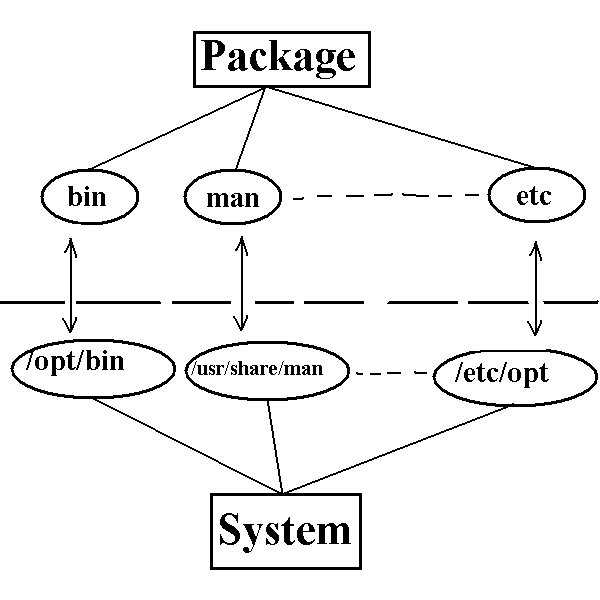
Conclusion
RESOURCE
"Linux Gazette...making Linux just a little more fun!"
Bomb ô Bomb, le premier jeu utilisant l'Addon
technology
By David Fauthoux
Français | English
Par exemple, on peut rajouter une page de présentation avec
une image de son choix en rajoutant les lignes
[Page]=

background=myPicture.gif
Et on peut coller plein d'animations partout simplement en rajoutant des
lignes comme "loop anim="... Et pour plus de simplicité, sur le
site on trouve plein de tutorials...
Bomb ô Bomb, the first game using the Addon technology
By David Fauthoux
English translation by Jason Kroll[Page]=
background=myPicture.gif
And one can stick full with animations everywhere simply by adding lines
like " loop anim ="... And for more simplicity, one finds the site
full of tutorials..
Copyright © 1999, David Fauthoux. Translation copyright Specialized Systems Consultants, Inc.
Published in Issue 46 of Linux Gazette, October 1999
"Linux Gazette...making Linux just a little more fun!"
An Overview of the Proc Filesystem
By Jay Fink
/proc filesystem. This "virtual" filesystem
has several key features which are interesting, useful and helpful. It can also
be dangerous and disastrous. This column will approach the /proc
filesystem in three areas:
/proc can be used for (or sometimes not to be used for)/proc as of the 2.2 Kernel on the i686 architectureWhat is
/proc?/proc filesystem is a direct reflection of the system kept in memory and represented in a hierarchal manner. The effort of the /proc filesystem is to provide an easy way to view kernel and information about currently running processes. As a result, some commands (ps for example) read /proc directly to get information about the state of the system. The premise behind /proc is to provide such information in a readable manner instead of having to invoke difficult to understand system calls.What
/proc can do for an Administrator/proc fs can be used for system related tasks such as:
/proc or query the kernel directly.Different Kernels = Different Capabilities
/proc. Some, all, or totally different layouts and capabilities may exist depending on your machine's kernel implementation.The Obligatory Warning
/proc (again because of distro's) there is no fool-proofing it other than only root may actually descend /proc and monkey with the files therein. I have found the easiest approach to be a sort of hacker method - backup your kernel and apply common sense when making alterations within the /proc fs./proc can be found at the The C10k problem document at Dan Kegel's Web Hostel.A Map of
/proc/proc with the 2.2 kernel on a Linux i686 architecture.
loadavgAverage of system load for the last 1, 5 and 15 minutes uptimeTime in seconds since boot-up and total time used by processes meminfoThe number of total, used and free bytes of memory and swap area(s) kmsgKernel messages that have yet to be read in by the kernel versionCurrent rev of the kernel and/or distribution (read from linux_bannercpuinfoRecognized processor parameters pciCurrent occupation of pci slots.self/Information about processes currently accessing /procnet/Descriptions about the network layer(s) scsi/Contains files with information on individual scsi devices mallocMonitoring provisions for kmalloc and kfree operationskcoreA core dump for the kernel (memory snapshot) modulesInformation regarding single loaded modules statGeneral Linux Statistics devicesInformation about kernel registered devices on the system interruptsInterrupt assignment information filesystemsExisting filesystem implementations ksymsSymbols exported by the kernel dmaOccupied DMA channels ioportsCurrently occupied IO ports smpIndividual information about CPU's if SMP is enabled cmdlineCommand line parameters passed to the kernel at boot time sys/Important kernel and network information mtabCurrently mounted filesystems mdMultiple device driver information (if enabled) rcEnhanced real time clock (if enabled) locksCurrently locked files Numbered Directories
Results May Vary
For More Information
Copyright © 1999, Jay Fink
Published in Issue 46 of Linux Gazette, October 1999
"Linux Gazette...making Linux just a little more fun!"
The Graphics Muse
By Michael J. Hammel

muse:

 elcome
to the Graphics Muse! Why a "muse"? Well, except for the sisters aspect,
the above definitions are pretty much the way I'd describe my own interest
in computer graphics: it keeps me deep in thought and it is a daily source
of inspiration.
elcome
to the Graphics Muse! Why a "muse"? Well, except for the sisters aspect,
the above definitions are pretty much the way I'd describe my own interest
in computer graphics: it keeps me deep in thought and it is a daily source
of inspiration.

 his
column is dedicated to the use, creation, distribution, and discussion
of computer graphics tools for Linux systems.
his
column is dedicated to the use, creation, distribution, and discussion
of computer graphics tools for Linux systems.
This month there really
isn't a new Muse column. At least not here in the Gazette.
In fact, there won't be any Muse columns in the Gazette anymore.
Nor will there be any more articles in my sister publication, TheGimp.com.
The Artists' Guide to the
Gimp
Available online from Fatbrain,
SoftPro
Books and Borders
Books. In Denver, try the Tattered
Cover Book Store.

The following links are
just starting points for finding more information about computer graphics
and multimedia in general for Linux systems. If you have some application
specific information for me, I'll add them to my other pages or you can
contact the maintainer of some other web site. I'll consider adding other
general references here, but application or site specific information needs
to go into one of the following general references and not listed here.
Online Magazines
and News sources
C|Net
Tech News
Linux
Weekly News
Linux
Today
Slashdot.org
TheGimp.com
Linux
Graphics
Linux
Sound/Midi Page
Linux
Artist.org
The
Gimp User and Gimp Developer Mailing Lists.
The
IRTC-L discussion list
comp.graphics.rendering.raytracing
comp.graphics.rendering.renderman
comp.graphics.api.opengl
comp.os.linux.announce
Future Directions
Check out Graphics-Muse.com
and find out!
© 1999
Michael
J. Hammel
Copyright © 1999, Michael J. Hammel
Published in Issue 46 of Linux Gazette, October 1999
"Linux Gazette...making Linux just a little more fun!"
The Cash and the Calling
By Brian Marshall
This paper analyzes a model of software development in which
closed-source applications make use of open-source artificial
intelligence parts. We begin by observing that AI has a huge
potential but that problems limit the development of
applications. We consider why there will continue
to be closed-source AI applications and note that pure
open-source development is limited by the number of
people interested in starting open-source projects.
We consider the possibility of closed-source applications
based on open-source parts, both in a two-tier and a
three-tier architecture. We look at the pool of talent
available for open-source projects. We conclude that
the use of open-source AI parts may significantly
increase the development of AI applications and that this
may be good for the state of the art of AI.
1. Introduction - Potential Applications of AI
There seems to be more potential applications for artificial intelligence
than actual. The untapped market for staff-scheduling alone is immense.
The opportunities in the areas of materials scheduling, process
optimization, expert decision-making and image interpretation seem
endless. The development of AI applications would appear to be a field
with a lot of potential for growth.
2. Closed-Source and Open-Source
3. Two-Tier AI: Closed Application, Open AI
4. Three-Tier AI: Application, Problem-Domain, AI
5. The Pool of Talent
6. Conclusion - The Potential of Open-Source AI Parts
7. Bibliography and Acknowledgements
http://www.tuxedo.org/~esr/writings/cathedral-bazaar/
http://www.tuxedo.org/~esr/writings/homesteading/
http://www.tuxedo.org/~esr/writings/magic-cauldron/
Copyright © 1999, Brian Marshall
Published in Issue 46 of Linux Gazette, October 1999
"Linux Gazette...making Linux just a little more fun!"
Using Sfdisk and Perl to fdisk a hard drive
By Mark Nielsen
Index:
Future updates for this article will be located at
http://www.tcu-inc.com/mark/articles/Sfdisk.html.
Resources
Introduction to Sfdisk the Perl Expect module
I am really getting mad at myself. I only tested this with RedHat 6.0 (again).
Debian would be a cool alternative.
IO-Stty-.02.tar.gz
IO-Tty-0.02.tar.gz
How to use Sfdisk to get information about your hard drive.
With RedHat 6.0, they included sfdisk by default. I guess the BSD games had to
go to save space. Anyways, here are some simple commands to get information
about the master hard drive on your primary controller to an PC compatible
computer.
/sbin/sfdisk -g /dev/hdd
Here is how to get the size (in bytes) of the total space of your hard drive,
/sbin/sfdisk -s /dev/hdd
Here is how to change the id of a partition 5 on your first hard drive to the
Linux partition,
sfdisk --change-id /dev/hdd 5 83
How to use Sfdisk to create or repartition your hard drive.
Well, one powerful feature of sfdisk is to repartition your hard drive or
create new partitions. Create a file called "Test.data" which has entries in the
following format, one per line, and the fields are comma delimited:
1,136
101,254,82
201,,83,*
/sbin/sfdisk /dev/hdd << Test.data
and then issue this command to see what you did
/sbin/sfdisk /dev/hdd
How to use Expect to delete all partitions on a hard drive.
The Perl script to delete all the
partitions is not something to be fooled around with. If you test it and
screw up your hard drive, it is your fault and not mine even if my script
doesn't work right. It is your risk.
chmod 755 Dufus_Move.pl
and then to do it on your slave hard drive on your secondary controller,
./Dufus_Move.pl d
How to use Expect to change the geometry of a hard drive.
The Perl script to change the
cylinders of a hard drive is not something to be fooled around with. If you
test it and screw up your hard drive, it is your fault and not mine even if my
script doesn't work right. It is your risk. chmod 755 Change_Cylinders.pl
and then to do it on your slave hard drive on your secondary controller,
./Change_Cylinders.pl d
Comments
Mark Nielsen
works as a database programming assistant at
The Computer Underground and as
a book binder for ZING and as a geek for
linux.com. Edited using Nedit and ispell.
Copyright © 1999, Mark Nielsen
Published in Issue 46 of Linux Gazette, October 1999
"Linux Gazette...making Linux just a little more fun!"
Linux Is Not For You
By nod
(if you are a normal everyday Joe)
# dmesg | less
	  Linux:  1 minute  47 seconds
	Windows:  2 minutes 37 seconds
Copyright © 1999, nod
Published in Issue 46 of Linux Gazette, October 1999
"Linux Gazette...making Linux just a little more fun!"
Linux Humor
By Mike Orr
When a program dies
what you need is a moment
of serenity.

The Coy.pm
module brings tranquillity
to your debugging.

The module alters
the behaviour of die and
warn (and croak and carp).

Like Carp.pm,
Coy reports errors from the
caller's point-of-view.

But it prefaces
the bad news of failure with
a soothing haiku.
A file that big?
It might be very useful.
But now it is gone.
	-- David J. Liszewski

Printer not ready.
Could be a fatal error.
Have a pen handy?
	-- Pat Davis

The Web site you seek
cannot be located but
endless others exist
	-- Joy Rothke

Windows NT crashed.
I am the Blue Screen of Death.
No one hears your screams.
	-- Peter Rothman
Copyright © 1999, Mike Orr
Published in Issue 46 of Linux Gazette, October 1999
"Linux Gazette...making Linux just a little more fun!"
Security for the Home Network
By JC Pollman and
Bill Mote
Prerequisites: This guide assumes that you have tcp wrapper and
ipchains installed, that you are running kernel 2.2.0 or higher, that you
have selected a legal/private domain name, that you're using IP Masquerade
to "hide" your machine from the internet, and that you are consistently
able to connect to the internet.
The script kiddie methodology is a simple one. Scan the Internet
for a specific weakness, when you find it, exploit it. Most of the tools
they use are automated, requiring little interaction. You launch the tool,
then come back several days later to get your results. No two tools
are alike, just as no two exploits are alike. However, most of the tools
use the same strategy. First, develop a database of IPs that can
be scanned. Then, scan those IPs for a specific vulnerability.
Once they find a vulnerable system and gain root, their first
step is normally to cover their tracks. They want to ensure you do
not know your system was hacked and cannot see nor log their actions.
Following this, they often use your system to scan other networks, or silently
monitor your own.
And now for the bad news: CERT®
Coordination Center has only one solution if you have been cracked:
reinstall everything from scratch!
ip
spoofing
What we will not be covering:
tcp
wrappers
ipchainsphysical security
specific programs you run
encrypting data
Here are some final
thoughts to whet your appetite. Next month we will be discussing dhcp.
Copyright © 1999, JC Pollman and Bill Mote
Published in Issue 46 of Linux Gazette, October 1999
# spoof protection on all current and future interfaces.
if [ -e /proc/sys/net/ipv4/conf/all/rp_filter
]; then
echo -n "Setting
up IP spoofing protection..."
for f in /proc/sys/net/ipv4/conf/*/rp_filter;
do
echo 1 > $f
done
echo "done."
else
echo PROBLEMS
SETTING UP IP SPOOFING PROTECTION. BE WORRIED.
echo "CONTROL-D
will exit from this shell and continue system startup."
echo
# Start a single
user shell on the console
/sbin/sulogin
$CONSOLE
fi






 The Mailbag!